

5-25-25
This part is less like a blog and more like a book. Enjoy…
The World Before Me: the Story of One Family’s RV Adventures Across the United States
“Afoot and light-hearted I take to the open road,
Healthy, free, the world before me,
The long brown path before me leading wherever I choose.”
- Walt Whitman’s “Song of the Open Road”
Charlottesville, Virginia
In 2021, our family of six embarked on a 2½-month road trip in an RV. My wife and I have always loved to travel, but with four young children—ages five to ten at the time—our adventures had been modest: a week here, a weekend there, and all within a few hours of our home in central Virginia. Then the pandemic arrived, flipping normal life on its head. Suddenly, we found ourselves sitting at home with much more time than we had ever had, and somewhere between Zoom classes and sourdough experiments, the idea of a bigger trip started to take root.
At first, it was just an idle thought, a vague notion of going somewhere, like everybody else. But as the months dragged on, we began to plan in earnest. A few late-night searches on RV forums turned into a full-fledged quest, and before long, we had a travel trailer sitting in the driveway. A renovation project followed, and then, with more anticipation than experience, we set out on a journey that has become the most meaningful and memorable thing we’ll probably ever do as a family.
When we returned, we sold the RV and everything in it, thinking we’d close that chapter of our lives. But the trip lingered in our minds, as good adventures tend to do. Over time, we realized that all six of us—kids included—were hooked. We wanted to do it again, and my wife and I resolved to make it happen before the kids’ enthusiasm waned or their teenage schedules filled with other priorities.
Two years later, we set off again—this time for a grander 7½-month adventure. The route was bigger, the pace slower, and the lessons richer. We crossed from Virginia to the Pacific, then wandered leisurely down the West Coast, from Washington’s evergreen shores to California’s beaches. From there, we explored a central swath of the country, ultimately circling back to South Florida. Between Olympic National Park, San Clemente, California and Key West, we managed to cover three of the four far corners of the Lower 48.
This second journey felt different. Our kids were older, which made everything from packing to road schooling a bit easier. The trip also stretched across seasons, from the crispness of fall to the depths of winter and back into spring. We celebrated holidays on the road, marked birthdays in unfamiliar towns, and settled into a rhythm that allowed us to experience not just the sights, but also the passing of time in a way our first, shorter trip hadn’t allowed.
This book is a series of essays about those journeys—part memoir, part how-to guide for anyone considering a similar leap. It’s written for the dreamers and planners, the vicarious travelers, and the brave few who might just decide to literally hitch up their own wagons and hit the road!
We know what we’ve done is unconventional. It’s not for everyone. But for us, these journeys have been transformative—an education in geography, family dynamics, and the art of slowing down. If anything in these pages sparks curiosity, inspiration, or even a laugh, we’ll consider it time well spent.
So, with that said, we are under way.

This was our first rig, near Scott’s Bluff, Nebraska
Staunton, Virginia
When we first started looking into RVs, we had no idea what we were doing. Like most people, we pictured massive motorhomes lumbering down the highway, a rolling contradiction of freedom and logistical headaches. But the more we learned, the more we realized that RVs came in every imaginable form, from tiny teardrop trailers to converted school buses. We had entered an entirely new world—one that was equal parts history, engineering, and personal taste.
The history of RVs is as adventurous as the people who drive them. In 1915, the Conklin family of Huntington, New York, embarked on a cross-country trip in an 8-ton vehicle they called the “Gypsy Van.” Built by a bus company, it had a generator, electric lighting, a kitchen, sleeping berths, and even a hidden bookcase—because of course. It was an astonishing invention for its time, though far from practical. The vehicle and living quarters were permanently fused together, making even a simple run to the store a complex operation.
As automobiles became more common, so did the idea of a portable home. By the 1920s, tent-trailers appeared, allowing travelers to hitch a makeshift campsite to their cars. By the 1930s, companies like the Covered Wagon Company were manufacturing hard-sided trailers, setting the foundation for the RV industry as we know it. Today, over 10 million Americans own an RV, and with the rise of remote work, the number is only growing. It didn’t take long for us to start wondering if this was something we could actually do.
Our family’s fascination with RVs started young. As a kid, I wandered through home shows with my dad in Charleston, West Virginia, mesmerized by the compact efficiency of campers there. The idea of a tiny home on wheels appealed to me in a way I couldn’t yet articulate. My wife grew up exposed to a different kind of tiny home, spending weeks and vacations sailing with her family on the Chesapeake Bay, and later throughout the Caribbean. These weren’t luxury cruises on elaborate yachts but rather more like camping trips on the water, the boats ranging from 30-40 feet in length and equipped with dinettes that converted to beds and a single, hand pumped head (toilet) for six people to share. She used to pore over her dad’s sailing magazines, looking for stories of live-aboard families who island-hopped around the world while homeschooling small, tow-headed children with minimal toy collections. Decades later, my wife brought up the idea of a big family trip—something adventurous but flexible, like those intrepid families on sailboats. That’s when the old interest of tiny home-living rekindled in both of us and we found ourselves spending hours browsing RV listings online.
One Saturday, we packed up our four kids and drove to an RV lot in Staunton, Virginia, just to see what was out there. The kids treated it like a treasure hunt, scrambling into different models and claiming bunks—“This would be my room!” “No, it’s mine!”—while we scrutinized the layouts. Though we didn’t know it at the time, we were laying the groundwork for what would become a major chapter of our lives.
The factory-made rigs were impressive in their own way, but the interiors felt generic. We quickly realized we didn’t want something fresh off the lot—we wanted something we could make our own. A new RV meant paying for a design we’d just want to rip apart. Instead, we focused on finding a used one to refurbish.
I started looking at ads for RVs, and to my surprise, found what we wanted in our own town. It was the right layout for our family of six, it was old enough that it did not feel wasteful to overhaul its interior, and the price was right. The only problem was feigning interest in how nice it was with the owner as I had no intention of doing anything but gutting it.
Once we found the right fixer-upper, the real work began. My wife had the vision; I had the tools (and the instructions). Out went the baffling window treatments, the sad carpeting, and the faux-leather stadium chairs. We painted the walls a clean white, refreshed the cabinets with earthy green paint, and installed lightweight, durable vinyl plank flooring. Peel-and-stick tile backsplashes added just enough charm without adding extra weight.
We swapped out light fixtures, replaced countertops with hardwood, and upgraded the notoriously terrible RV mattresses to something that didn’t feel like a punishment. I ambitiously installed a deeper kitchen sink—only to realize why the original one was so shallow. Some design choices actually do make sense in small spaces.
Televisions? Gone. Instead, we packed a projector and a pull-down screen, turning our rolling home into a pop-up movie theater for Harry Potter marathons and National Geographic documentaries about the places we were visiting.
By the time we finished, our trailer wasn’t just a vehicle—it was home. And with that, it was ready to hit the road.
Of course, a trailer needs a way to move, and that meant buying a truck. We weren’t exactly in the market for a massive tow vehicle before this adventure, but necessity dictated otherwise. After some research and a few test drives, we landed on a used Ford F250 from a commercial truck lot. It had the power we needed without the price tag of something new, and it even came with a truck cap and a rack up top.
That brought us to the next question: how were we paying for all this?
Our ability to embark on these long adventures boils down to one thing: timing. Specifically, the kind of timing that lets you step away from the daily grind without abandoning your professional life. I’m fortunate to have built a seasonal career as a camp director, running Field Camp in Charlottesville, Virginia, since 2000. While the work is not exactly confined to summer—it tends to creep into the margins of the calendar—it is most intensive during those hot, pool-side months. By mid-August, camp is winding down, and I’m usually left with this seven-month window of flexibility. For us, that window has been like a golden ticket: ample time for a cross-country odyssey without a breakneck pace or some deadline drawing us back home.
For our first trip, we were modest but functional. Between the trailer, the improvements, and the truck, we invested about $60,000 in the whole setup. The plan was to sell the whole thing when finished and hope we could get most of it back. In a quirk of prices associated with the pandemic, we nearly recouped the entire amount when we sold the rig after the trip. That meant our biggest expenses boiled down to fuel, campground fees, and admissions to various sites—probably around $10,000 for the entire adventure. For 2 1⁄2 months of housing, transportation, and memories we’ll carry for the rest of our lives, that felt like a bargain. At some point, we realized that if we’d rented our house out during our trip, we’d have softened the blow even further.
I realize how rare this is. If not for my seasonal work and the stability of a business that can miss me for a while, this kind of extended travel would have been just another item on a wistful wish list. There’s no getting around it: extended RV living takes resources, both financial and logistical. On our first trip, we managed to make it work in a way that felt relatively thrifty, though that’s largely because RV resale values and the quirks of our personal circumstances have worked in our favor.
We had planned so much of the trip thoroughly and in advance, but we did not give the same attention to scheduling the campgrounds. My wife and I had travelled plenty, and we figured that we would be travelling in the fall low season when plenty of places would be available. Sure, I thought, we might struggle on the weekends, but we’ll find something. This mostly would have worked, but a few weeks before we left, we talked to friends of the family who were two years into living in an Airstream, and when I asked him how far out he usually made reservations, he said, “oh, I try to stay at least six months ahead on that.” Two weeks out, I felt a bit of a panic, and subsequently scheduled almost all the 29 campgrounds for the entire first trip in the next few days. We lucked out due to timing and our route, but we wouldn’t be nearly so unprepared for the second go-round.

We enjoyed this broad view of the Puget Sound at Fort Flagler’s State Park campground in WA.

Our first RV’s interior, with a projected image on the right wall.

Looking a little cramped here during a morning school session.
Sandusky, Ohio
Our first trip finally began on Labor Day Monday, 2021. We had parked the RV on our camp property after finishing the renovation in the spring, then ignored it all summer while camp was in session. When camp ended, we had about a week to wrap up loose ends before turning to the final trip preparations. We parked the rig on the street in front of our house, hoping the neighbors wouldn’t mind the behemoth sitting there for a few days. Then began the great migration—clothes, food, supplies—all packed methodically into our new home on wheels. We had electricity hooked up but no sewer, so bathroom breaks and dishwashing still required a quick jog back into the house.
After several days of careful loading, we hitched up the truck, crossed our fingers, and slowly rolled out of the neighborhood, marveling that this was actually happening. My wife’s mom and a few neighbors stood by to wave us off, and with that, we were on our way.
We were heading out for two and a half months. We had pondered going longer, but we didn’t want to miss Thanksgiving and Christmas with family, and the thought of being out there during winter was intimidating. We also were wary about driving all the weight through the western mountains. So we looked at the map and decided we would venture up through Michigan, across the upper Midwest to South Dakota, then down through Colorado and New Mexico in order to avoid the steep mountain grades. We would return across Texas, hitting some favorite spots there and in Louisiana, and then visit sites in Florida before returning home. We had been interested in traveling across Ontario so that we could visit all five of the Great Lakes, but we worried that pandemic-related border closures might spoil those plans, so we stayed within the country and managed to visit four of the lakes.
An hour after leaving, and still adjusting to the surreal feeling of dragging five tons behind us, we pulled into a church parking lot off Interstate 81 for lunch. It was our first realization that RV travel involves an entirely new way of looking at space. Not just inside the trailer, where every item has to earn its keep, but outside—figuring out where, exactly, something this large can even go. Still, the random church parking lot had everything we really needed at the moment–plenty of open space to maneuver– because we were carrying everything else we really needed–lunch and a bathroom. There was none of the road trip food hassle–inferior quality, long lines, limited selection, dirty bathroom, pandemic crowd anxieties, etc. Instead, we set our folding chairs out under our awning and made turkey and tomato sandwiches. It was great!
Looking back, we should have been more wary of the GPS route through the mountains. At the time, though, we had no idea that charming little towns with scenic streets could be a nightmare for a truck and trailer. When we took a wrong turn in the middle of town and had to figure out a way to turn around–no problem without a trailer–we were so lucky to find a route around that didn’t require backing up. The important thing was that we made it to our first campground. Now, all we had to do was figure out how everything worked.
In Ohiopyle, Pennsylvania, our first stop, we faced the challenge of squeezing our rig into an impossibly long, backwards site, assigned to us by a park ranger. It was wedged between trees and a picnic table cemented into place, requiring several hundred feet of circuitous backing and near-military precision to park. Ironically, over several years and hundreds of campgrounds, this first spot would be the most difficult we ever came across. But there was an easy fix. We drove back to the gate and got a new assignment!
There’s a classic brain-teaser involving a house and three utilities—electricity, water, and gas—and the impossible task of connecting each to the home without crossing any lines. An RV presents a similar conundrum, though slightly less abstract. While a few rugged rigs like Sprinter vans can operate off the grid, most RVs rely heavily on their hookups. Electricity, water, sewer—sometimes even cable TV and internet—all converge on your home-on-wheels like lifelines tethering a wayward astronaut.
On our second night, in Sandusky, Ohio, we arrived at a Lake Erie campground with a bit more confidence. Parking went smoothly. Then came the water hookup. Once again, a foreign mechanism baffled us, but this time we didn’t have to fumble too long before an RV neighbor stepped in to help. This was the first of many instances when fellow campers came to the rescue. RV parks, we learned, have their own culture—one where advice is freely given, usually with a knowing smile that says, “Yep, we’ve all been there.”
Electricity is another campground staple, available in 20, 30, or 50-amp varieties depending on how many gadgets and appliances you expect to run. Plugging in powers lights, the fridge, air conditioning, and more. When hookups aren’t available, a generator is the backup plan, though the constant hum of generators in boondocking areas is both a comfort and a nuisance—an odd blend of self-sufficiency and shared noise pollution.
And then there’s the sewer, the least glamorous but arguably most critical utility. RVs come equipped with a gray water tank (for sink and shower runoff) and a black water tank (for, well, you know) . If your campground offers a direct sewer hookup, you can avoid the dreaded tank dump, or as a friend calls it, the “tank release,” by attaching what another friend has dubbed the “stinky slinky.” Properly connecting this flexible pipe, with its latex-gloved rituals and careful downward slope, is an art form. Done correctly, it’s hassle-free. Done poorly… Well, let’s just say you’ll only make that mistake once.
Speaking of mistakes, our next stop in Michigan offered a lesson in sewer management we’d rather forget. Let’s just say that if you’re ever unsure whether a valve is open or closed, triple-check before unscrewing anything. If not, you might find yourself scrambling for paper towels and hoping the next guy in line is also a newbie. The phrase “lesson learned” doesn’t quite do it justice.
Propane rounds out the essential utilities, powering the stove, fridge, and heater when electricity isn’t a sufficient option. Refilling the tanks is a simple chore, made easier by the fact that most campgrounds offer the service. Meanwhile, cable TV hookups remain a staple at many private campgrounds, though they feel like relics of a bygone era. We never bothered, but plenty of campers still do—especially during college football season, judging by the tangle of cables we saw in neighboring RVs.
The final modern necessity, of course, was wifi. Technically, we could survive without it, but let’s be honest—it was essential for planning, navigating, and the occasional movie night. Campgrounds often brag about their wifi, but the reality is grim. More often than not, we relied on our phones as hotspots, assuming we had decent cell service. In many campgrounds, connectivity is an afterthought, leaving you either delightfully unplugged or frustratingly stranded in an internet dead zone. Eventually, we resorted to getting satellite internet service, which wasn’t without its issues also, but it tended to be the best option out there, judging by the number of such devices in the higher end campgrounds.
Sure, managing an RV’s utilities may seem like a minor part of the adventure. But figuring it all out—through trial, error, and a fair amount of Googling—is part of the charm. You learn to appreciate the small victories, like a strong wifi signal or a sewer hose that drains perfectly. And with each hookup, you’re reminded that even on the open road, modern conveniences are never far behind.

Parked for several days near Lake Michigan, with everything out–canoe, bikes, picnic supplies.
Grand Haven, Michigan
Just before the pandemic lockdowns began, my wife took a trip to Iceland with her sister and best friend. Iceland isn’t a big country, so back home in Virginia, the kids and I found a Reykjavik webcam aimed at Hallgrímskirkja Church, near where she mentioned they’d be having dinner. The church’s grand facade was beautifully lit against the long February night, and since it was dark most of the day, the webcam’s view was mostly still and serene. We called her and asked if they could walk past the church, hoping for a brief glimpse.
What we got was pure magic. Out of nowhere, wild shadows began dancing across the church’s facade. Though the figures themselves were barely visible in the dim light, their dramatic silhouettes leapt and twirled on the wall. There was no mistaking it—it was them, putting on an impromptu shadow show. The kids were thrilled, delighted to “see” their mom halfway around the world, even if just as shadows. It was a heartwarming highlight of the week, even if it did cost her a mandatory quarantine upon returning from Europe that March day that international travel all but shut down.
Ever since, we’ve been devoted fans of worldwide webcams, with Earthcam reigning supreme in the genre. Their online service, “EarthCamTV.com,” lets you peek into a hundred or so corners of the globe, with scenes rotating every minute. During the pandemic, we kept Earthcam running on our living room projector almost non-stop, finding solace in the familiar bustle of far-off towns and serene vistas. It was a small but vital connection to a world that felt suddenly out of reach.
While planning our trip, we realized just how much Earthcam had influenced us. Our itinerary included several destinations we’d first discovered through its lenses: Bourbon Street in New Orleans, the town square in Jackson, Wyoming, a lively bar in Key West, and Cincinnati’s Roebling Bridge. Even more delightful were the unplanned moments when we stumbled across scenes we already knew by heart. The best surprise? Grand Haven, Michigan. The Earthcam there overlooks two picturesque lighthouses marking the entrance to the Grand River. We’d admired them countless times online but had no idea our reserved campground would offer a direct view of the very same lighthouses. It felt like reuniting with an old friend—one we’d only ever known through a screen. Better yet, the walk out to the lighthouse made a promenade that extended all the way back to town along the parklike banks of the Grand River, and we enjoyed watching the boat traffic along the surprisingly wavy water on our evening strolls.
None of us had ever visited Michigan, and we spent a delightful 10 days there in four campgrounds along Lakes Michigan and Superior. I visited a whole variety of hardware stores along the way as I was trying to work out some plumbing kinks, but most of our memories of those cool September days involve ice cream shops, hiking, Sleeping Bear Dunes National Monument, the boat ride to Mackinac Island and the immensity of Lake Superior. We had gotten into a nice groove at two weeks in and felt much more confident about ourselves as hardy RV travelers.

At wonderful Grand Haven State Park, Grand Haven, Michigan. The campground is in the center of the photograph along the shore. The promenade extended back into town and made for a lovely evening walk, for seemingly much of the town!
Munising, Michigan
After dinner, we often strolled through campgrounds, taking note of the various camping setups around us. While some made little effort, plenty of campers considered their site as a sort of second home, complete with flags, houseplants, and welcome mats on their porches. So many of the campers we met seemed to live in more rural areas, and were drawn to the closer communities of the campgrounds. By the time we’d made it to the Upper Peninsula of Michigan, we could count ten distinct categories of RVs, ranked here from the most modest and affordable to the most luxurious and elaborate:
Of course, within each category, there’s a wide range. While tents are generally the simplest and least expensive option, some are part of elaborate glamping setups, complete with string lights, full hookups, and Instagram-worthy aesthetics. Conversely, you occasionally spot a weathered Class A RV that looks like it has limped into the campground on sheer determination and duct tape alone.
Tents were most often seen on weekends, often occupied by younger campers, families, or first-timers giving the outdoors a go. Tenting is the essence of camping: it’s affordable, accessible, and a fair trial-by-fire for the uninitiated. It’s also the least forgiving, requiring significant effort and exposing campers to every whim of nature. Those who camp in tents are, in many ways, the unsung heroes of the camping world. We’d spot them everywhere, not just in campgrounds, but also in far-flung places like Yosemite’s El Capitan, where climbers pitched tents precariously on the vertical granite face.
Pop-up campers are those unassuming rectangular boxes that transform into canvas-covered shelters with a bit of ingenuity and elbow grease. They get you off the ground and offer more comfort than a tent, but their fabric sides leave them vulnerable to the elements. Rain is the nemesis of pop-ups, and once mold sets into the canvas, it’s nearly impossible to evict. That said, these little trailers are budget-friendly and great for anyone looking to dip their toes into RV life without committing to a pricier rig.
Perched on the beds of pickup trucks, truck campers offer a snug escape from the elements. Their compact interiors are better suited for couples or solo travelers who don’t mind climbing over each other to get in and out of bed. While they’re a step up in comfort from tents, they require some gymnastics and patience, especially for older travelers. Still, for those who already own a truck, these campers provide a practical and relatively inexpensive way to explore the open road.
Bumper-pull travel trailers were probably the most ubiquitous RVs we encountered. These rigs offer many of the comforts of home at a relatively affordable price, but they’re not without their challenges. Pulling a trailer requires vigilance, as an overly heavy or poorly balanced load can cause it to sway alarmingly. Sway bars can help stabilize the setup, but they come with their own limitations, particularly when making tight turns or backing into a campsite. Despite these quirks, trailers remain a popular choice for those looking to balance comfort and cost. Probably half of all the trailers we saw had a slideout or two or three. Once parked, you can push buttons attached to electric motors that move them in or out pretty effortlessly. The only real challenge about them, besides the fact that they tend to be the most leak-prone parts of your rig, is in packing things in order to collapse the wall and then resetting some items (rugs, chairs, etc.) once you’re parked. You will probably find the added room worth all the hassle. A trailer is 8 feet wide at most without slides, but that can increase to 14 feet with both sides extended, and that feels like a pretty normal sized living room.
Airstreams are the snobs of the RV world. With their sleek aluminum exteriors and reputation for durability, they command prices that reflect their prestige. While a standard trailer might cost around $25,000, an Airstream of similar size perhaps starts at $100,000. They’re designed to minimize leaks—a common scourge in RVs—and their timeless design has yet to be dethroned by a competitor. Without the added room provided by slides, however, they always feel tight to me. Owning an Airstream is as much about the lifestyle as it is about the camper itself, and these polished behemoths hold their value better than other RVs. Our campground in Munising was half filled with Airstreams, whose owners like to meet up and celebrate their unique trailers over weekends. The couple beside us was older than most, and one evening, I watched this man go out to polish up the aluminum sides of his trailer. This was remarkable as he had to use a walker for mobility. Perhaps they liked travelling with fellow Airstream owners because they knew they could count on their help. Nevertheless, the episode was reassuring. I thought, “if they can do it at their age, surely we can make this work!” Then again, they didn’t have four kids.
Fifth wheels are the giants of the trailer family, attached to a hitch mounted in the bed of a pickup truck for better stability and towing ease. They seem to always include slides, and their size allows for luxuries like multiple bedrooms, full kitchens, and even fireplaces. Most fifth wheels are occupied, like all other RVs, by older couples, but these were also common among bigger families like ours, including 430 square feet with two-and-a-half bedrooms, a bathroom, and a roomy kitchen-living room combo. “Roomy” is, of course, relative when you’re living with other people in a space smaller than most studio apartments, but they seemed downright palatial compared to some RV setups. Fifth wheels often include ingenious features like lofted sleeping spaces for kids, “garages” for equipment, and even toy haulers designed to transport ATVs or motorcycles.
Beyond trailers, there’s the motorhome side of the RV spectrum, starting with vans like Sprinters and other small camper vans, then moving to mid sized Class Cs, and culminating in the palatial Class As, which look like shiny tour buses. These setups offer the convenience of being self-propelled, which is both a blessing and a curse—you never have to hitch or unhitch anything, but your entire house has to go with you every time you need a carton of milk. Interestingly, the smallest category of camper vans is often referred to as Sprinters or simply “camper vans,” but technically, they belong to the Class B category. This designation raises a baffling question: why “Class B”? It’s not as though the RV classes follow any obvious alphabetical order. We have Class Cs, which are larger than Bs, and Class As, which are larger than both. By this logic, Class Bs sit awkwardly in the middle. Was the term coined by someone with an alphabetically dyslexic streak, or was it just a bureaucratic quirk that stuck? No one seems to use the term anyway, perhaps because it raises more questions than it answers.
Each type of RV has its quirks, strengths, and downsides, and we encountered them all on our travels, from the rugged minimalists in tents to the retirees luxuriating in their decked-out Class As. What’s right for you depends on your budget, your tolerance for hardship, and how much room you need for your kids, pets, and maybe even a golf cart. But rest assured, no matter what category you fall into, there’s a place for you in the vast and varied world of RV camping.
And by the way, if you want to look around for yourself, there’s no better time to do so than at an RV show. We’ve been to 3 or 4 now. Unlike the sales lot, where you’re escorted from rig to rig by a salesman (who probably knows little more than you about the variety on the lot), you can see a couple hundred setups at a show in the space of an hour or two. Better yet, the dealers seem not to want to have to drive the things back home, so they make better deals there. You sometimes see the phrase “RV Show Prices” which suggests dramatic markdowns from the sticker prices, and it certainly seems like a real thing to us.

That’s an F-250 diesel with a tow package and room for 6!
Wausau, Wisconsin
RVs are small homes on wheels, but let’s not kid ourselves—they’re not exactly well built. They can’t be. If you want to tow one without renting a crane, it has to be constructed with lightweight materials, which means trade-offs. Start disassembling one, as I’ve had the dubious pleasure of doing, and you’ll quickly see evidence of mass production and cost-saving shortcuts. Combine that with the sheer number of systems crammed into one vehicle—plumbing, electrical, HVAC, and more—and it’s no surprise that RVs are notorious for developing problems. Sometimes these problems are there when you buy the thing, sometimes you create them yourself, and sometimes they seem to spring out of nowhere, just to test your patience.
Our first RV was a 2009 KZ Spree Bunkhouse that we sometimes called “Harvey the RV,” and it was no exception. It came preloaded with the issues we knew about, such as minor water damage that had delaminated the exterior walls in two spots. Then there were the problems we created ourselves—like failing to fully test the plumbing after installing new countertops and sinks. But the real test was the problem we didn’t see coming.
After about a month, we were feeling pretty pleased with ourselves. Six campgrounds in, we’d mastered the basics: setting up, breaking down, and rolling out like seasoned pros. The kids, now aged 5-10, were content with our well-oiled routine, and we were on track to reach the next campsite just outside Wausau, Wisconsin in 30 minutes. That’s when we heard the sound.
Pop.
It was loud enough, ominous, and entirely unwelcome. The trailer jolted slightly, and I immediately suspected a blowout. Sure enough, the right rear trailer tire had blown. You may never have seen a truck on the side of the road with a blowout, but after it’s happened to you, you may start to notice that it’s not uncommon on hot summer pavement. Fortunately, the trailer had dual tires on each side, so we could limp along to the next exit, where we found a flat, open and empty parking lot beside a storage facility. Not exactly picturesque, but at least we were safe.
The tires had seemed relatively new when we bought the trailer, but I’ve since learned that trailer tires can be fickle. Their lifespan isn’t measured so much in miles as in time, and sitting unused for years can be just as damaging as frequent use. Friction creates heat, of course, and tires will succumb to the heat if they have any weak spots. It was an oversight on my part, but hindsight is always 20/20—or in this case, 20/flat.
Changing the tire should have been straightforward. We had a spare, and I started jacking up the trailer with reasonable confidence. After all, I was jacking up the trailer to make it level at every campsite! The first snag was the tire iron—a flimsy piece of junk that might as well have been made of tinfoil. Somehow, I managed to loosen a few lug nuts before hitting the real showstopper: one of the bolts was stripped. The tire iron couldn’t get any purchase, and after a frustrating half hour of futile attempts, I had to admit defeat.
Meanwhile, my wife called AAA. A cheerful recorded message assured her that help would arrive within 90 minutes, but as the minutes ticked by, it became clear that central Wisconsin’s tow truck operators had other priorities on a fall Saturday afternoon—possibly football, possibly beer, but definitely not us.
With the kids growing restless, anxious, and hungry, we made the call to unhook the trailer and drive to the nearest town. We figured the kids were the first priority and I could sort out the trailer problem more easily without worrying about them. My wife took the kids to a curiously round-shaped hotel in Wausau, where they ordered pizza and watched TV, creating memories that were either charming or traumatic, depending on which child you ask. The hotel had a big enough parking lot, so I drove back to get the trailer, and limped all the way to the hotel and parked it there overnight.
I assumed we would be spending the next few days in Wausau. However, the next morning, I found salvation at a Fleet Farm, a magical big-box store that not only had the tires I needed but was also open on a Sunday. I still marvel at our luck. The staff initially claimed they were too busy to help me, but I’ve learned that persistence—and parking conspicuously out front—can work wonders. After securing four new tires (two per shopping cart), I borrowed a tool to deal with the stripped bolt and set to work. By some miracle, I managed to replace all four tires in about an hour, depositing the old ones in the store’s oversized trash can. I just wish I’d snapped a picture of the tires absurdly sticking out of that container.
By 10 a.m., I was rolling again, and an hour later, we were reunited in our rolling home, sweet home. The kids were thrilled to be back on the move, and my wife and I were just relieved to have dodged what could have been a much worse ordeal. Imagine if the blowout had happened in the desolation of West Texas—or worse, five minutes into the trip. We might have turned around and never left town.
Looking back, the experience was humbling but oddly satisfying. There’s something about overcoming a challenge like that—standing in a Fleet Farm parking lot, hauling oversized tires in mismatched shopping carts, and finally hitting the road again—that makes you feel like you can handle just about anything. And when you’re driving your house down the road, that’s a good mindset to have.

The October 18, 2023 schedule for Seattle, Washington
South Dakota
Somewhere in the middle of South Dakota, cruising along I-90 at nearly 80 mph, a familiar nagging thought crept in again. Was this just an extended vacation? Shouldn’t I be doing something more productive—securing my retirement, furthering my career, working toward some tangible goal? It wasn’t a new worry; it had been lurking since we started planning this trip, surfacing at odd moments, usually when the kids were bickering or when I calculated just how much we were spending. But then, I’d look back at them laughing in the back seat, the RV rolling steadily behind us, and I’d remind myself: this was the point. This was the investment. Retirement could wait—time with them could not.
After a week in Minnesota, bouncing between a beautiful suburban campground near Minneapolis and a remote one in the southwestern corner of the state, we finally reached South Dakota, the northwesternmost edge of our route. Our first stop was near Sioux Falls, a surprisingly charming city with a fantastic network of bike trails and a stunning series of waterfalls running right through town. We spent hours exploring by bike, following the paved trails that wound through parks, past historic buildings, and along the Big Sioux River. It was one of those places that felt unexpectedly easy and pleasant—just the right balance of urban convenience and natural beauty.
From Sioux Falls, we continued west, covering long, hypnotic stretches of highway where the road stretched out in an endless, ruler-straight line. We made shockingly good time.
We spent a couple of nights in Wall, South Dakota, a place best described as a kitschy tourist trap perched on the edge of something truly magnificent. Badlands National Park, just to the south, is a mesmerizing, otherworldly landscape of eroded rock and dramatic, desolate beauty. We wandered its trails, stood at the edge of vast canyons, and tried to imagine the shock of the first pioneers who stumbled upon this place. Wall, by contrast, offered an over-the-top stretch of souvenir shops, and endless billboards touting free ice water at Wall Drug. The contrast was almost comical, but it was hard not to love it just a little.
Then came Spearfish City Park, a hidden gem nestled in the Black Hills. We arrived late in the season, just in time to watch the park empty out for winter. By our last night, it felt like we had the entire place to ourselves—a quiet, tree-lined sanctuary with a trout stream winding through it. We spent hours riding bikes in a loop around the empty park, pedaling into town for breakfast or ice cream, feeling for a brief moment like Spearfish was our own little secret.
From there, we moved just south to Custer State Park, one of the greatest surprises of the trip. Sure, people come here for Mount Rushmore, and we dutifully made our pilgrimage to see the iconic faces carved into stone. But Rushmore, as impressive as it is, was only a fraction of what made this place special. Custer State Park was vast, untamed, and filled with the kind of scenery that leaves you wondering how it could possibly not be a national park. The scenic drives alone—twisting through tunnels, winding past granite spires, revealing sweeping vistas of open prairie—were worth the trip. And then there were the bison, enormous and indifferent, wandering freely in herds, blocking roads as if they owned the place. Or so we heard. Strangely, we didn’t see one until the day we were leaving in nearby Wind Cave National Park.
One of our favorite rituals on the road was the evening campground walk. Every stop had its own distinct cast of characters, but one trend was impossible to miss: we were almost always the youngest people there, particularly during the weekdays. RV parks are filled, overwhelmingly, with retirees, folks who had done their decades in offices and now had the time, the savings, and the carefully selected rigs to match their vision of travel. It was hard not to feel a little out of place.
I knew that, eventually, I would be one of them—or at least some version of them. But I also knew that I didn’t want to wait for retirement to do something like this. I wasn’t ready to disappear into the full-time RV life, but I was also certain that this was a fleeting opportunity. In fifteen years, my wife and I probably won’t be traveling the country in an RV. Maybe we’ll be exploring Europe, or sailing along some distant coast, but we won’t be doing this—not with four kids still willing (or obligated) to come along.
So, we took this trip now, because we could. Years from now, my kids will either remember it as a grand adventure or an absurd, hilarious chapter of their childhood. And because, for me, there’s no better trade-off than stealing time like this, tucking it away in the bank of memories, and knowing that—just for a little while—I chose this over everything else.

Meredith relaxing on the couch while the kids played in the campground.
Renovations
Scott’s Bluff, Nebraska
Before we embarked on our first RV adventure, we were complete novices in the art of rolling home life. Sure, we’d done plenty of camping, and my wife had logged her fair share of time on extended sailing trips, which gave us some useful survival skills. But when it came to RV-specific know-how, we had plenty of gaps to fill.
For example, where would we park the RV? On moving days, we spent an extraordinary amount of time and mental energy on this one, because you can’t just park it anywhere. You needed about 90 feet of free space, and generally a through-road on the other end. The campgrounds were generally built with this in mind. As you might imagine, the public offerings tended to provide plenty of room, while the private operations always packed you into a smaller space in order to maximize the revenue. The campgrounds could be challenging, but practically every one of our fellow RV owners there was predictably understanding and accommodating. The RV industry sells plenty of gadgets designed to help you park your rig–backup cameras, sliding hitches, etc. You probably don’t need any of these things, however, and will do just fine getting to where you need to go (just be careful at Ohiopyle State Park).
Take groceries, for instance. How much should we pack? How much space did we even have? Would there always be a grocery store nearby? The answers revealed themselves quickly: stock up when you can, but don’t get overzealous. RV storage space, no matter how ample it may seem at first glance, will humble you. However tempting it might be, there is no place for a Costco run on your RV tour.
Our fifth wheel had far more storage than the travel trailer we started with, so we could, in theory, stock up for weeks at a time. In practice, though, we usually went to the store every few days. Fortunately, most campgrounds were conveniently close to a grocery store. When they weren’t—as in the unremarkable Scotts Bluff, Nebraska—we learned to plan ahead. But honestly, I didn’t mind the grocery runs. It gave me a chance to explore the subtle (and not-so-subtle) regional quirks of supermarkets.
Most grocery stores in the U.S. are remarkably alike—right down to the chips aisle, which seems to be cloned and shipped to every store from Seattle to Key West. A grocery stocker in one town could seamlessly switch jobs with their counterpart in another, no training required. Still, there were highlights, like the delightfully cheerful Trader Joe’s locations we made a point of visiting whenever we could. I also tried to buy local foods when possible, but those opportunities were disappointingly rare. Quality local grocery stores are about as common as startup automobile companies.
Then there were the logistics of getting packages. Could we order anything while on the road? The short answer: not easily. After years of relying on Amazon deliveries like clockwork, we had to adjust to a more old-school style of shopping. Some people have packages sent to campgrounds, where they pile up at the front office. Amazon lockers were another option, provided you could anticipate your whereabouts with precision. I ended up retrieving a package at Chapman University in Orange County, California, a school I didn’t even know existed until Amazon cheerfully informed me my order was waiting there.

The wonderful municipal campground in Spearfish, South Dakota featured a trout stream.
Monument, Colorado
After spending several days in Denver, we headed south on I-25 toward New Mexico, hugging the eastern edge of the Front Range of the Rocky Mountains. To the left, the prairie stretched endlessly, flat and open, disappearing into the horizon. To the right, the mountains loomed, their jagged peaks stark against the sky. Occasionally, Pike’s Peak came into view, a towering reminder of just how small we were out here. I always kept one eye on the weather forecast, and I knew we were in for a windy day. But with the winds blowing west rather than south, I figured we’d be spared the worst of it.
As we drove, I kept a close watch on the truck’s RPMs and gas mileage. Normally, the automatic transmission hovered between 9th and 10th gears, shifting smoothly, but today, with the wind pressing against us, it was jumping between 7th and 9th. I could hear the engine working harder, and feel the extra strain. The weather app confirmed my suspicions—15-25 mph winds, with occasional gusts. Soon, we started spotting semi-trucks pulled over on the shoulder, likely waiting for calmer conditions.
Wind is one of those invisible forces that can turn a perfectly stable drive into a white-knuckle affair, especially for anyone towing a trailer. Crosswinds can push a rig off course, and if a trailer starts to sway, it can take the tow vehicle with it. We’d done our homework before setting off, outfitting our rig with a sway bar attachment—a stabilizer designed to minimize side-to-side motion. I wasn’t entirely sure how much it would help in a real-world scenario, but on this day, I was grateful for it. Even as the truck strained, we never felt unsafe, just aware of how much effort the drive was taking. It was a day that reaffirmed something I had already suspected: when it comes to towing, more truck is always better than less.
Before venturing into the world of RVing, I was blissfully ignorant of the complexities of towing capacity. My experience had been limited to hauling the occasional load of mulch or moving furniture with a utility trailer. I had assumed—wrongly, as it turned out—that pickup trucks were built to pull just about anything. It didn’t take long to realize that towing is a rabbit hole of engineering considerations, weight calculations, and acronyms that sound more like algebra than automotive specs.
Most pickup truck owners probably don’t know how little they can actually tow. The classifications—half-ton, three-quarter-ton, one-ton—are relics from an earlier era, when a truck’s designation directly correlated with its payload. Advances in engineering have muddled these distinctions. A modern half-ton truck, like a Ford F-150 or its Chevy and Dodge equivalents, can handle more than its name implies, often carrying upwards of 1,500 pounds. But towing capacity is an entirely different beast. It depends on a convoluted mix of factors: frame strength, suspension, braking system, engine size, and the enigmatic but all-important axle ratio.
Towing numbers vary wildly. A basic one-ton truck might tow 5,000 pounds or 13,500, depending on its setup. A diesel-powered three-quarter-ton truck could be rated anywhere from 15,000 to 23,000 pounds. And then there are the big boys—heavy-duty F-350s and their ilk—capable of hauling jaw-dropping numbers, sometimes topping 40,000 pounds under optimal conditions. The problem isn’t finding a truck that can tow; it’s figuring out what your specific truck can handle.
Car salesmen, I discovered, are not much help. Few of them seem to know anything about tow ratings beyond the numbers printed on a glossy brochure. Sometimes they’ll even tell you that a truck on the lot doesn’t have a hitch, when it clearly does. Dealership ads are even worse, often touting best-case scenarios that have little to do with real-world towing. I eventually learned that the only reliable source is the manufacturer’s Trailer Towing Guide—a dense document buried in the depths of corporate websites or collecting dust in a dealership backroom.
To decode your truck’s capacity, you need to know more than just the engine size. The axle ratio, drive type, and even bed length all play a role. Our 2023 F-350 diesel 4×4 with a 6¾-foot bed and a 3.55 axle ratio has a listed towing capacity of 22,000 pounds, or 25,600 for a fifth-wheel. That’s a lot of numbers, but they matter.
One common misconception is that towing capacity is listed on the driver’s door frame. It isn’t. Those numbers typically relate to tire load limits, which are useful for ensuring your tires don’t explode under weight but have nothing to do with what the truck itself can tow.
All of this made me more appreciative of the fact that we had chosen wisely. There are plenty of people who underestimate the strain that towing puts on a vehicle, leading to white-knuckle drives and mechanical failures. After that windy day in Colorado, I became even more convinced: if I ever did this again, I would always err on the side of more truck rather than less.

The screen traces the paths of our 2 trips. The 1st is a circle going up thru Michigan and back down through Colorado & New Mexico, while the 2nd goes across the middle then to 3 corners–Washington, California, and Florida. The northeastern photos were not part of these trips.
Angel Fire, New Mexico
That same drive south of Denver remained a challenge even after the winds died down and we turned west onto Route 64, heading toward our campground in Angel Fire, New Mexico. We had anticipated the mountains ahead might be our most challenging section of our drive, but we didn’t quite know what to expect. Northeastern New Mexico felt especially desolate, even by the state’s already sparse standards. As we approached the mountains, the landscape shifted, and with it, the nagging anticipation of what lay ahead.
At first, the climb seemed manageable. The road was curvy, but our truck handled it well, making its slow, steady ascent. What caught me off guard was just how steep it was. “Really? Big mountains. In New Mexico? Who knew?” I mused, though I was sure that locals would scoff at my ignorance. We pulled over occasionally to let faster cars pass, watching the temperature drop as we gained elevation.
Then, as we neared the pass, the trouble began. Our youngest had been snacking—too many meat sticks, it turned out—and the winding roads proved too much for her stomach. In an instant, our smooth drive was derailed by a backseat disaster. We pulled over to clean her up, the chaos briefly overshadowing the impressive scenery. Probably the stress of the early and middle parts of the drive was rubbing off on all the passengers. Angel Fire felt farther away than ever.
Eventually, we got back on the road and finished the climb. When we finally arrived at the campground, it felt like a victory. And, as it turned out, we had saved a surprise for the kids—our first stay at an RV “resort.” It was a cut above our usual stops: manicured sites, mountain-lodge-style facilities, waffles for breakfast, hot tubs, and panoramic views. We settled in, hosed off the car seat, and let the stress of the drive melt away.
After several blissful days in Angel Fire, we set out for Santa Fe, climbing back up another winding Route 64 pass. This drive, while easier, delivered the closest call of our entire trip. On one particularly sharp turn, a flatbed truck hauling a forklift suddenly appeared ahead, well over the centerline and barreling seemingly straight toward us.
There was no time to think—only react. I hit the brake and veered toward the mountainside, hugging the shoulder as the truck roared past, missing us by what felt like inches. I checked the rearview mirror and saw it clear us with maybe a foot to spare. For a moment, I sat frozen, the adrenaline still coursing. But there was no time to dwell on it—we were still climbing, and I had no idea how much of the ascent remained.
That moment stuck with us. It became the warning we carried in the back of our minds anytime we debated whether to take an unfamiliar road. But looking back, that was the worst of it. A blown tire in Wisconsin, a scraped vent cover, a frozen hitch, a dying truck battery—none of it compared to that near miss.
Towing an RV, I had learned, was an exercise in constant vigilance. There was always something to watch, some calculation to consider. Our trip had thrown a few surprises our way, but the road had also taught us something valuable: most challenges are never as daunting as the fear of them. We had faced steep climbs, high winds, car sickness, and a too-close-for-comfort near miss. And yet, the adventure was still worth it. Every mile, every challenge, was another story to tell.

Moose, Tetons National Park
Balmorhea State Park, Texas
Our summer camp property in Charlottesville is built around an unusual and historic swimming pool constructed in 1913. When we bought the place in 2010, our curiosity about historic pools ignited, and suddenly, every century-old swimming hole in the country became a destination worth noting. As we planned our RV trip, these spots became waypoints on our journey—each one an oasis, a relic of a different era when public pools were grand iconoclastic projects rather than chlorinated rectangles behind chain-link fences.
One of these remarkable pools was built in the 1930s in San Solomon Springs, Texas, as part of Balmorhea State Park. Like many pools of that era, it originated as a natural spring, a place where people had gathered to swim long before anyone thought to build infrastructure around it. The Civilian Conservation Corps, in its admirable quest to enhance public spaces, transformed it into a grand swimming pool—3.5 million gallons of spring-fed water, plunging down to 25 feet in some places, teeming with fish and turtles. And there it sat, improbably, just off I-10 in the otherwise desolate expanse of West Texas.
By the time we arrived in October, the air was warm enough to make the 74-degree water feel refreshing rather than bracing. There’s something surreal about swimming in a pool so vast it feels more like a lake, particularly one as clear and alive as this. In that arid part of the world, Balmorhea is a genuine oasis, and after our swim, we left with a renewed mission: to seek out every historic pool we could find.
Texas, it turns out, has about half of the best swimming holes in the country (the other half are mostly in Florida), so it wasn’t long before we found ourselves en route to the best of them all—Barton Springs in Austin. If there’s a heaven designed for swimmers, it likely resembles Barton Springs. If you don’t believe it, go there and a swimmer there will be telling you this soon enough. The magic of Texas swimming holes is largely a function of geology—the springs bubble up where the hills meet the plains, and Austin sits right on that divide. The water here spills from the limestone of the west, emerging in Barton Springs at a blissful, unchanging 70 degrees.
We camped at Lake Travis State Park and made our way to Barton Springs on our first day in town. Nestled in the heart of Zilker Park, the pool is both a natural wonder and a city institution. It wasn’t surprising, then, that when we arrived, it was closed for cleaning. Anyone familiar with municipal bureaucracy will understand why the city had neglected to update its phone message or Google listing. These things happen.
Barton Springs, we learned, is designed to keep the spring water pristine by diverting Barton Creek around it, ensuring the main pool remains untouched by the sediment-heavy creek flow. However, when Austin gets too much rain, the diversion system gets overwhelmed, and creek water floods into the spring, necessitating a thorough cleaning. Unfortunately, we had arrived on one of those rare cleaning days.
But nature had a workaround. Just downstream of the fenced-off spring area, the spring water still flowed freely, (of course) and here we found a delightful discovery: Barking Springs. If Barton Springs is Austin’s crown jewel of swimming, Barking Springs is its unkempt, joyous younger sibling—a place where dogs and their owners frolic with equal enthusiasm. It was chaos in the best way, and somehow, missing the main pool didn’t feel like much of a loss.
The next day, Barton Springs reopened, and we returned. The water was clear, cold, and full of people. Of course, with 27 million gallons of fresh water running through the springs daily, it never takes long for it to refresh itself. Looking back, we realized that our growing obsession with historic pools wasn’t just about the water—it was about the tradition, the enduring appeal of a perfect swim, and the way these places connect generations. And really, who could pass up a good swim?

Stargazing, Moab, Utah
Destin, Florida
Our youngest daughter, the extrovert, makes friends wherever we go, and that often leads to conversations with fellow travelers. It was during one such encounter that my wife met a father from Indiana at a Thousand Trails Florida campground pool. He was eager to talk her into signing up for their membership program, particularly for the benefits in Florida. Thousand Trails is a franchise that offers members an upfront fee for “free” stays across the country, a rare example of organization in a field otherwise dominated by small, independent campgrounds. We weren’t remotely interested, however, as our experience there and at similar campgrounds had been decidedly underwhelming. My wife’s first instinct was to ask him, “Have you been to a Florida State Park?”
Our first visit to one was Henderson Beach State Park in Destin. Behind our site was a boardwalk winding through the dunes to a pristine stretch of white sand beach, with the shallow waters of the Gulf of Mexico lapping at the shore in an array of blues and light greens. From our site, we couldn’t see another camper; the native bushes and trees surrounded us, creating a sense of seclusion despite the proximity to other campers. The sun set gently to the right, casting a warm glow over the scene. Just a few miles down the coast, the high-rise buildings and dense suburban sprawl of Destin seemed a world away. We didn’t have full hookups (water and electricity yes, but no sewer), but a clean, modern bathhouse was a mere 75 yards away, offering showers, a coin-operated washer and dryer, and a spacious sink area for dishwashing. Other campers, working as volunteer hosts in exchange for their spots, were always busy and, it seemed, genuinely content to be there. We even enjoyed biking down the campground road to another beach, where low-speed limits and designated bike paths made the experience feel safe, even for our youngest, who was just six at the time.
We figured this might be an isolated experience, as state park quality can vary from place to place, but soon enough, we would find that Florida’s state parks have a consistent standard of excellence. We lucked into a one-night reservation at Fort Clinch State Park on Florida’s very northeastern corner, at another RV campground sitting right on the beach at the end of our journey. It was stormy and windy while we were there, and not a great time to look around, but the little we saw suggested again that it was no fluke that it was so extraordinarily difficult to secure a reservation in the Florida State Parks.
Our success in securing reservations at these popular parks has come entirely through cancellations. You can try to book a spot directly through the Florida State Parks website, where reservations open up 11 months in advance at 8 a.m. each day. But despite my best efforts, I have had little luck that way. I know that Taylor Swift tickets have been hard to come by for the Eras tour, but my impression is that finagling a spot to see Tay-Tay is way easier than getting a two-week stay at Curry Hammock State Park.
The only way we were able to book the Florida State Parks was through Wandering Labs, an online service that monitors the state park site for cancellations, alerting you by text and email as soon as a spot opens up. When you get the notification, you have to act fast—sometimes dropping everything to log in and reserve before the spot is gone. I’ve been successful about one out of three times, though I’ve never managed to get a spot without competing against dozens of others (on one occasion, I saw a site that had 60 people watching). Persistence—and fast fingers—are key. I write this at the risk of inviting more competition for these spots, but as a new resident of Florida, I may well not need this avenue in the future anyway!
One feature of the otherwise simple Wandering Labs website is that the various park reservations are ordered on the front page by highest demand. It was initially a surprise to see that 8 of the top ten most in-demand public campgrounds in the U.S. (including national parks) were Florida State Parks. The other two were the campground by El Cap in Yosemite and a Florida county Park (Fort DeSoto). After visiting just these two state parks, however, we understood the appeal, particularly in the winter.
And here’s the kicker—cost. While we spent almost $500 for four nights at Thousand Trails in Clermont, Florida outside Orlando, our stays in Florida State Parks have never cost more than $42 per night. So, no, our campground friend, we won’t be signing up for Thousand Trails anytime soon, and certainly not in Florida.


A Few Old Friends We Saw on the Road: Scott, Aidan, and Ivy
Orlando, Florida
One of the weaknesses of modern education is its devotion to plans and standards—systems devised, with the best of intentions, by people who rarely set foot in a classroom. These systems can be so rigid that they leave little room for the kind of spontaneous, real-world learning that can make an impression far more lasting than any test prep session. As a history teacher in a prep school blessed with some autonomy, I’ve always tried to take advantage of the opportunities that arise in the present. History is, after all, not just something that happened long ago but something that is happening now.
Take Election Day, for instance. At the middle school where I taught, our local polling precinct was conveniently located just across the street. On the first Tuesday in November, when we were indeed in session, I’d lead my classes on a short pilgrimage to observe democracy in action. My students took note of the signs and campaign workers gathered outside, the orderly routine of voters lining up to cast their ballots, and the demographic skew toward retirees who had the luxury of mid-morning free time. These small moments, woven into the fabric of their day, offered a deeper, more visceral lesson about civic duty than any textbook ever could.
Holidays on the road offered their own opportunities for adventure. Before embarking on our trip, we’d looked online to see if we could find an over-the-top town for the holiday. Was there a place that was worth planning the trip around so that we could be there on October 31st?
We struck gold near Orlando, where we realized we were close enough to spend the evening in Celebration, the Disney-developed community renowned for its meticulous planning and enthusiastic residents. Celebration went all out, with houses decked in extravagant decorations, endless streams of costumed kids, and candy galore. It was a Halloween extravaganza that lived up to the magic of its creators.
That experience made an impression, and we resolved that we would be careful to take advantage of such opportunities should we ever try this again. The costumed revelers of Orlando reminded us of the richness of the world when we simply let it unfold around us. Plus, it gave us the opportunity to reflect on how cities have evolved through the lens of the more and more common planned communities. Some lessons don’t need planning; they just need a willingness to show up.

Campgrounds are the best places for biking.
Savannah, Georgia
Our final stop on that first long road trip was Savannah, Georgia—a city we already knew well for its Southern charm, Gothic architecture, Forrest Gump benches, and orderly European-style squares that seem to invite both wandering and reflection. We settled into Skidaway Island State Park, nestled in the lush coastal lowlands just south of town. The visitor center surprised us with an unexpectedly captivating museum and nature exhibit—a deep dive into the region’s rich natural history that turned out to be far more fascinating than any of us had anticipated.
We also knew a storm was coming. A tropical system had been steadily churning up the coast, and we quickly learned that RV life, quaint and cozy under blue skies, loses much of its rustic charm when the rain starts hammering down in sheets. Our once-picturesque campsite turned into a swamp overnight. Stepping out of the trailer felt like a competitive sport—dodging puddles deep enough to justify hiring a lifeguard. After days of relentless downpours, we found ourselves scrambling for things to do. Shopping kept us dry, but with every corner of the RV already crammed with essentials, we had no room for anything new. Still, a walk around the local mall kept us mildly entertained for an afternoon. By the time we left Savannah, we were more than ready to head home.
Returning after months on the road was jarring. The first thing that hit me was the sheer size of our house. If you’ve ever gone camping for a weekend and come back home to find your living room suddenly cavernous, multiply that by months and several thousand square feet, and you’ll have a sense of what we felt. After living in a few hundred square feet of carefully managed space, our home—with its sprawling hallways, high ceilings, and empty air we were now paying to heat—felt absurdly, almost comically, oversized.
And then there was the stuff—so much stuff. After months of living with only what we could carry, returning to closets stuffed with forgotten clothes and plastic bins filled with “just in case” items felt overwhelming. On the road, every object had to justify its place. If something came in, something else had to go—a system that, paradoxically, felt freeing rather than restrictive. At home, surrounded by decades of accumulation, I couldn’t help but wonder why I’d held onto so much for so long. The vague idea that I might need something “someday” now seemed laughably flimsy. The trip had made it clear: modern life thrives on accumulation, but it doesn’t have to.
Beyond the physical space and the clutter, it was the rhythm of RV life that stuck with me most—a rhythm that was slower, more intentional, and deeply engaging. We spent nearly every waking moment together, not just sharing space but truly participating in each other’s days. With no friends for our kids to disappear with, they turned to each other–and to us. We hiked together, explored together, and filled our days with discovery. Every day offered something new to see or do, and life felt rich with movement and meaning.Back home, I didn’t want those lessons to slip away. We didn’t need all this space. We didn’t need all this stuff. And we didn’t need another cross-country road trip to keep exploring or stay connected with the world around us. We could keep hiking, keep discovering, and approach our own backyard with the same curiosity we had carried across thousands of miles. Most importantly, I wanted to hold onto that sense of intention—to teach my kids not just through travel, but through the way we lived every single day. The journey didn’t have to end just because we had parked the RV.

Monarch butterflies, Pismo Beach, California
Charlottesville, Virginia
Within days of our return, life had resumed its usual rhythms. We caught up with friends and family, sent the kids back to school, tackled a mountain of postponed appointments, and threw ourselves into a new round of offseason camp projects. The RV sat in the driveway for a while as we slowly cleaned it out, but before I had to worry about winterizing it, we put it on the market. To my surprise, it sold quickly and for full price—likely a testament to all the renovations we had poured into it, not to mention the still-continuing pandemic-related vacation choices. With the trailer gone, we sold the truck as well, and just like that, the rig that had carried us across the country was gone.
But it didn’t take long before I found myself scrolling through trailer ads again, wondering if something smaller might be more practical for weekend trips and summer camp use. I had seen one-bedroom R-Pods in campgrounds and thought that perhaps a compact model could be the right fit. So, on my birthday that winter, I bought a small trailer and spent the next few months renovating it. Compared to our previous overhaul, this was a quick and relatively easy job, and once it was finished, we took it on its maiden voyage to Kiptopeke State Park near Cape Charles, Virginia.
The verdict? Too small.
We had to sleep three to a bed and keep our overnight bags in the Sprinter van we towed with because there was no space to put the clothing and gear of six people. Waking up in the morning we probably resembled clowns exiting a vehicle, as one more person, then one more person, then one more person, and so on… stepped outside into the fresh air.
Our kids made a friend at the campground, and when the eight-year-old learned that all of us were squeezed into the R-Pod, she looked genuinely horrified. We used it for one additional trip, but deep down, I knew it wasn’t going to see much action. Still, the experience kept us thinking—and talking—about another big adventure.
As the months passed, we found ourselves reminiscing more and more about where we had been a year before. The kids had started back at school—elementary and middle—and we realized that if we were ever going to take another extended trip, we had just one realistic window left. Once our two oldest entered high school, pulling them away for months at a time simply wouldn’t be an option.
The idea snowballed. We began making mental lists of places we had yet to see. When I came across a viral drone video shot in a Minneapolis bowling alley, I found myself checking to see exactly where it was. The EarthCams of national parks still beckoned. And then, one night at dinner, we had the inevitable conversation.
“Well, do you guys want to go on another big trip?”
After a few questions—some of which we had no real answers to yet (“Where will we go?” “How long?” “Will Nannie visit us?”)—the kids nodded their heads. We were going back out there.
Having tackled big projects before, I knew this would become our dominant passion for the next few years. In fact, from that dinner table conversation to our eventual departure, it would take two years of planning and execution before it was all over.
This time, we had experience on our side. We debated what to buy, briefly considering a motorhome, but ultimately leaning toward a fifth wheel—especially one with a loft, which seemed like an ideal space for our son. With the idea from a friend who deemed motorhomes less safe, we settled early on searching for a used Jayco fifth wheel to renovate, yet again, to our taste and needs.
With more lead time, we also planned our route more carefully. From the first trip, we knew we could always find a place to stay in a pinch, but with the luxury of advance booking, we aimed for the best campgrounds available. Mistakes were still made, lessons still learned, but we entered this adventure feeling older, wiser, and far more confident in what we were doing.
The first step was sketching out an itinerary. Our dream list included the grand western parks—Yellowstone, Yosemite, and the Grand Canyon—along with stops in Glenwood Springs, Colorado; Cannon Beach, Oregon; San Clemente, California; and a host of Florida state parks. We wanted a balance of rural beauty and the occasional urban excursion. We also planned to organize our trip a bit more around campgrounds this time around.
Timing was crucial. Leaving in September meant we needed to hit the western parks early before winter made them impassable. Snow could fall in Yellowstone as early as the second week of October. The first month, then, would be a whirlwind—Colorado, Utah, Wyoming, Montana, and Idaho—before reaching the West Coast by mid-October. From there, we’d drift down through California, zigzagging between the coast and the mountains, weather permitting. The second half of the trip would be a leisurely cross-country return through the South, ending with a month and a half of Florida’s subtropical state parks.
Meanwhile, we needed to find a used fifth wheel trailer. After extensive research and visits to RV lots, we settled on a Jayco Eagle MBQS 355 with a mid-bunk room and loft. It gave our three girls and son separate spaces while also providing a cozy rear living area with plenty of windows and an electric fireplace. We found a used one in Gloucester, Virginia, and after a quick negotiation, the owner himself delivered it to our driveway, where it would sit for six months as we renovated it.
We spent $43,000 on the trailer and another $15,000 on the renovation—new tires, a repaired slide, flooring, lighting, paint, furniture, and countless smaller upgrades. It was an investment, but by the time we finished, it felt like a cozy home.
With the trailer in place, we turned to the next challenge: finding a truck capable of hauling it. The used truck market was still overheated, so we decided to custom order exactly what we needed. In the fall of 2022, we placed a deposit on a Ford F-350 with a fifth-wheel prep package, towing capacity over 18,000 pounds, and seating for six—an increasingly rare configuration.
Six months later, when our order finally arrived, it wasn’t the truck we had requested. After a frantic nationwide search, we found the right truck in Holland, Michigan. I flew there to buy it, then drove it back home in a nearly nonstop sprint—pausing only for a single night in Pittsburgh before rolling into our driveway, triumphant.
The financial side of the trip was another puzzle. This time, we planned ahead and listed our house on Airbnb, earning about $25,000 while we were gone. Our total investment in the RV and truck was around $125,000, with the hope of selling both for $85,000 upon return—effectively making our “rent” for the year about $40,000, equivalent to what we would have spent on private school tuition had we stayed home.
Other costs included admissions ($2,000), fuel ($6,000), and campgrounds ($10,000), though we found state parks to be the most affordable and pleasant option. By the time we factored in saved expenses and house rental income, the trip ultimately cost us about what we would have spent had we stayed home.
And so, after months of preparation and planning, we were ready. With our newly renovated trailer, companion truck, and an itinerary mapped across the country, we were set for another great adventure. This time, we weren’t just hopeful travelers—we were seasoned veterans, ready to hit the road with confidence. The first trip had been an experiment. This one felt like a mastery course in the fine art of RV life.

Alligators–plenty of them–at Myakka River State Park near Sarasota, Florida.
Cincinnati, Ohio
For the second trip, we renovated the trailer and secured the truck in the spring, but then mostly let it sit idle while we ran our summer camp. This time, however, we were careful to do a local test trip to see if we had any issues, and indeed we did—ones that we promptly handed over to a local RV dealer to sort out.
Once camp wrapped up, we had two weeks leading up to our departure, and those weeks became a logistical circus: moving into the trailer while simultaneously moving out of our house. The latter proved to be the more arduous task, as we had decided to rent out the house while we were gone. It was one thing to embark on a long trip, but quite another to leave behind a house in pristine, Airbnb-ready condition.
Renting the house required a ruthless purge of six years’ worth of accumulated stuff, much of it enthusiastically collected by our children. Toys, clothes, school projects—all had to be sorted, donated, or shoved into storage. At the same time, the house needed sprucing up, which somehow turned into minor renovations we hadn’t planned on. Meanwhile, the trailer was a moving target. Getting it “ready” is an ever-evolving concept, as there’s always something else to fix, pack, or second-guess. But somehow, in the midst of all this chaos, we managed to get both the house and trailer to a state of functional readiness—or close enough.
And then, we hit the road. Our first day’s drive took us four and a half hours west to Huntington, West Virginia. It was not a smooth start. While the neighbors’ kids settled back into the comforting rhythms of the school year, ours were flung into the unsettling business of upheaval. Moving is jarring enough for adults; for kids, it’s downright disorienting. They missed their friends, their routines, the predictability of knowing what came next.
Their unease fed our own doubts. Were we making a terrible mistake? What kind of parents uproot their kids’ lives for the sake of a long road trip? But I reminded myself that our first RV adventure had started with the same growing pains, and eventually, we had all settled into the journey.
“It doesn’t even feel like the big trip yet,” one of the kids grumbled, unimpressed by the proximity of Huntington to our usual stomping grounds. She wasn’t wrong. West Virginia, where I grew up and where we often visited family, hardly felt like a bold leap into the unknown. Even the fact that a skydiving operation was part of our campground with an up-close view of parachuted jumpers and vintage biplanes wasn’t enough of a distraction. Maybe getting farther away would help.
The second night brought us to Cincinnati. We had spent evenings earlier in the year planning for the trip, and we decided that our roadschooling needed some structure. I happen to be one of the rare people who has actually started a fully functioning school, so we figured we might as well go through those same founding rituals for our own mobile academy.
We voted on a mascot—the wild turkeys. We chose colors—those of an actual wild turkey, mostly browns and white with touches of light blue and pink. We bought school uniforms (khaki pants/skirts, white collared shirts, and patterned kerchiefs). Our school, This Land School, had a motto (“This is the way” or “Learning by exploring”), a school poem (Walt Whitman’s “Song of the Open Road”), and a school song (Woody Guthrie’s “This Land is Your Land”). We even created a daily and annual school calendar, which we mostly followed. It was an amusing but effective way to give our road school some legitimacy.
In Cincinnati, we held our first official school convocation at Smale Riverfront Park, in view of the historic John A. Roebling Bridge—fittingly, a bridge to our new adventure. Had you been so inclined, you could have spotted our ceremony via the bridge’s EarthCam on Tuesday, September 5, 2023, at 10 a.m. We found a stone labyrinth there, and after introducing all the pupils, we walked it, marking the start of our academic year on the road.
The tone was triumphant, but the rest of the day brought us back to practical matters—specifically, a critical weight-loss campaign. When we left home, we had been confident in our truck’s ability to handle the load. What we hadn’t done was double-check the Gross Vehicle Weight Rating (GVWR) of the trailer.
For our 2018 Jayco fifth wheel, the GVWR was 14,995 pounds. The trailer’s “dry weight” was 12,335 pounds (according to Jayco’s official specs), but that was before renovations (which likely added a few hundred pounds), or the additional weight of water, supplies, and an alarming amount of books, clothes, and pantry snacks.
We had absentmindedly assumed we’d stay under the limit. How much could food, clothes, and workbooks possibly weigh? Quite a bit, as it turned out. A routine stop at a truck stop scale the day before had delivered the verdict: we were a few hundred pounds over. A few hundred pounds might not have been an immediate problem, but we weren’t about to roll into a seven-month trip carrying excess baggage.
Cue the frantic weight purge in a Cincinnati campground.
Appalachian Trail hikers often shed unnecessary items after a few grueling days on the trail, and we took a similarly ruthless approach to our trailer. Rarely used items like a generator and spare bikes were relocated to the truck bed (which still had plenty of GVWR room). Heavy objects were tossed altogether—including, most famously, the girls’ bedroom’s heavy glass door. It had been awkwardly positioned anyway and was replaced with a curtain that was lighter, more practical, and, frankly, better looking.
Had we continued down the highway overweight, nothing catastrophic might have happened—but we weren’t interested in testing that theory. An overloaded trailer means unnecessary strain on everything from tires to suspension, and the last thing we needed was to invite mechanical failure into our carefully planned adventure.
After our Cincinnati purge, subsequent weigh-ins showed us well within limits, and the experience left us with a valuable lesson: everything you carry has a cost. It’s a mindset that has lingered long after the trip, reminding us to think twice before acquiring new things—whether or not we’re towing them down a bumpy highway. Sometimes, it’s not just the weight you carry, but the freedom of letting it go.

Sunset at Pismo Beach
Denver, Colorado
So we pressed on. After two days in Cincinnati, we spent two nights at a campground in St. Charles just north of St. Louis, and visited the Arch, perhaps mostly to dip our toes in the Mississippi River, and the extraordinary City Museum. You have probably heard of the former, but the latter is way more interesting and fun. It’s the brainchild of welder and artist Bob Cassilly, and hard to say quite what it is as I’ve never visited anything quite like it. Housed in an old shoe factory, it’s a sprawling, eccentric delight, teeming with sculpted dinosaurs, tunnels, slides, and even a school bus dangling off the roof. There’s a Ferris wheel up there, too. It’s vast, indescribable, and we’ll definitely be back. It was among our kids’ few favorites from a hundred possibilities. Next, we made our way across Missouri and spent another two nights in Kansas City, drove along State Line Road and in the middle of town and posed hundreds of “what if” questions, and enjoyed barbeque at a local music venue. My meal came in a jar! We found a delightful record store there and our son bought a vintage Beatles album. With one more night spent in Wakeeney, Kansas, we finally got to Denver within a week. We’d made it through the part of the trip that worried us most: the unsettled transition. Now we could slow down and focus on the journey’s real purpose—seeing as much of the West as possible before hitting the coast by mid-October. We called this Phase 2: leisurely stays of two to four nights at some of the Rockies’ most stunning outdoor destinations. By this point, we were mostly—though not entirely—settled into our new rhythm.
And then came the mountains.
Our first travel day after Denver proved to be one of the most harrowing of the trip. We’d known we’d have to cross the Rockies, but in our naivete, we assumed the hardest parts wouldn’t come right away. I must have had some idea that the mountains would be taller in the middle, not right when you start in. The Rockies, I imagined, would start gradually, and build toward a grand precipice midway through. I must have held this thought even though I’d travelled through Colorado already several times! The more I think about it, my naivete about the mountains is just startling.
The climb began innocuously enough. Our truck handled the ascent with ease, outpacing the lumbering semis as we climbed into the clouds. But as the interstate grade signs began to appear—“Steep Down Grades 2.5 Miles Ahead”—a new kind of dread set in. The uphill was fine; it was the downhill that gave us pause.
Rain began to fall steadily, and traffic slowed to a crawl. Alternate routes through smaller passes popped up on the GPS, but we stuck with the interstate, figuring its predictability was preferable to the unknown. After passing through the 1.7-mile-long Eisenhower-Johnson Memorial Tunnel at the Continental Divide, we began our descent. The signs grew increasingly ominous: “Truckers, Don’t Be Fooled: 4 More Miles of Steep Grades.”
White-knuckled but determined, we made it through, exiting the interstate just shy of our campground. A two-lane road paralleled the highway and the nascent Colorado River, leading us to a quaint crossroads charmingly named No Name, Colorado. It was here, mere moments from our destination, that I made a bonehead move.
Perhaps it was the anticipation of finally arriving, or perhaps it was my distracted mind, but I took a left turn just a little too sharply. It’s usually the less visible right turns that spell trouble, but I’d managed to hit the side that was so obvious if I’d just been paying attention. The trailer’s midsection clipped a temporary concrete embankment that had shifted from a hillside. The sound was sickening. My vocabulary, at that moment, was colorful.
After berating myself for what felt like an amateur mistake (“How many more times will I wreck this thing in six months?”), I inspected the damage. Mercifully, it was cosmetic. A scrape, a scar—nothing that would affect function. We rolled into the campground, chastened but intact.
Since then, I’ve made a point of taking every left turn with as much care as I was in making the right turns. The trailer bears its battle scar with dignity, a silent reminder that the journey is as much about learning from missteps as it is about reaching the destination.

Lunch along the Gallatin River, between Big Sky and Bozeman, Montana
Glenwood Springs, Colorado
Two weeks into our journey, we were spending our second of three nights in Hurricane, Utah. We had driven there from Colorado after an eventful week that felt like the perfect blend of chaos and discovery. Our three-night stay at Chatfield State Park, on Denver’s southern edge, had become a hub for reconnecting with old friends. Our friend Ivy, currently between jobs, generously hosted us for much of two days, making up for lost time with long conversations and shared meals.
In Carbondale, we visited our friend Scott, who had recently embraced married life on a beautiful farm with his wife, Victoria. Their menagerie included three donkeys, a golden retriever, and a yak. Yes, a yak—an animal that somehow exudes both grandeur and bafflement in equal measure. From there, we met up with our friend Aidan and explored yet another of the historic swimming pools on our itinerary: El Dorado Springs.
This pool, perhaps the oldest classic swimming pool in the country, first opened in 1905 and once attracted visitors as a premier resort destination. Though its heyday has long since passed, the pool remains a regional attraction nestled outside a beautiful canyon and state park. Owned by a water company that bottles and sells the spring water, the pool now seems more like a charming afterthought. Over the past five years, the owners have poured $7 million into refurbishment, yet as of our visit, it remained closed, with hopes of reopening in May 2024.
Our second stop on the historic pool tour was the more renowned Glenwood Hot Springs Pool, a few hours west of Denver along I-70. This pool, steeped in resort history, could be described as the grand dame of U.S. soaking spots. Its water, emerging from the earth at a blistering 124 degrees and heavy with salt, undergoes careful cooling for the hot pool (104 degrees) and warm pool (90 degrees). Despite the salt’s natural cleansing properties, the water remains a fertile ground for algae, requiring treatment with an ionizer. The sheer volume—1.2 million gallons—turns over daily, an impressive feat considering its source lies deep beneath the towering Rockies.
By now, we had started to settle into our routine, though the kinks in our trailer—and our plans—kept us on our toes. Finding a consistent rhythm was proving elusive. For instance, we thought we had a brake problem on our brand-new truck. But after a squeaky trip to Jiffy Lube, we learned it was likely harmless debris—the brakes were still pristine. The kids seemed to be enjoying themselves—or at least adapting. They diligently tackled their schoolwork and tried to lend a hand, though like most children their age, their enthusiasm for chores was selective. Clear plans and explicit directions proved crucial to keeping the peace, though these were sometimes elusive for us. The journey required a certain flexibility—one that, at times, tested our patience but also kept us engaged.
Next came Moab, and our only experience with boondocking. We stayed at a rustic federal government property campground called Ken’s Lake, running our generator a bit during the day but mostly living off our batteries and water tank. The most memorable sight in Moab, even more impressive than Arches National Park, were the heavens–a remote spot that gave us our best view of the Moon and stars of our whole trip.
My wife and I shared occasional updates on Facebook and Instagram, where friends followed our adventures with curiosity and encouragement. Staying connected to home in this way felt comforting, a reminder of the life we had momentarily left behind. The outpouring of interest and support from friends made me feel profoundly lucky to be on this journey, bumps and all.

Hiking at Elkhorn Slough, near Monterey Bay, California. Like much of the rest of California, the slough was filled with birds, and one of the myriad great places we found to hike and enjoy the varied landscapes across the country.
Springdale, Utah
On our first trip, we optimistically strapped a rarely used green canoe to the top of our truck, figuring it wouldn’t add much weight and would open up a world of aquatic possibilities. The truck—bought used and already equipped with a sturdy rack above its topper—seemed the perfect rig for such adventures. I imagined us gliding down tranquil rivers and across scenic lakes. In reality, the canoe’s greatest contribution turned out to be as a beacon in crowded parking lots. It was much easier to spot our vehicle when it had a big green boat perched on top. We used the canoe for paddling exactly three times. Even then, it felt precarious, especially with young kids aboard, each wobble threatening to capsize both the vessel and my parental confidence. When planning our second trip, we left the canoe behind without a second thought.
Bicycles, however, earned their place in our travel arsenal, despite being an undeniable hassle. We had invested in a brand name version of what looked like a formidable bike rack (rhymes with “Yule”), allegedly capable of holding six bikes. Unfortunately, it turned out that “capable” was a generous term, especially with the girls’ angled step-through frames, which bike racks tend to treat as an unwelcome anomaly. Securing their bikes was a daily exercise in frustration, involving creative solutions and some colorful language. Worse, the rack itself rattled ominously behind our fifth wheel, loosening bolts on both the contraption and the bikes. By the end of the trip, all six bikes were little more than rattling heaps of scrap metal held together by stubbornness and metaphorical duct tape.
Still, those bikes were worth every ounce of effort. Campgrounds, as it turns out, are bike-riding paradises. With strict speed limits—firmly reinforced by signs and even firmer retirees eager to shout “SLOW DOWN!” at anyone exceeding 10 miles per hour—the kids could pedal freely without much worry. Beyond the campgrounds, we sought out bike paths whenever possible, and the West, blessed with a thriving bike culture, rarely disappointed.
In the Grand Tetons, we pedaled along a scenic path as a moose loped gracefully on the far side of the road, a sight that was both exhilarating and humbling. Zion National Park offered a workout in the form of a steep uphill climb, rewarded by a joyous downhill glide on the way back. In St. Charles, Missouri, we had circled a gorgeous lake brimming with wildlife near the Missouri and Mississippi Rivers. Spearfish, South Dakota, had introduced us to a charming municipal park with a circuit ride that felt like a hidden gem. We explored neighborhoods in Seattle and Sioux Falls, and pedaled to pristine beaches in Florida’s Henderson Beach and Topsail State Parks.
The rise of e-bikes was hard to miss on these rides. They’re a welcome new option for older riders or anyone deterred by challenging terrain. E-bike enthusiasts often had radiant smiles plastered across their faces, the joy of effortless exploration evident as they zipped along. These bikes seemed to be doing wonders for getting more people outside, moving, and enjoying the world around them.
That said, e-bikes weren’t without controversy. While most riders seemed to use them responsibly—often pedaling at least enough to give the illusion of effort—there were notable exceptions. Younger, perfectly fit riders in particular tended to treat e-bikes like toys, speeding recklessly and startling pedestrians. In Sedona, Arizona, where hiking reigns supreme, e-bikes were explicitly banned from trails, likely a response to this kind of misuse. It’s a shame, because e-bikes offer so much potential for accessibility. One hopes that the reckless few don’t ruin it for everyone else, especially the older or less mobile riders for whom these options are so vital.
For us, our battered, bolt-loosened bikes were enough to keep us connected to the landscapes we traversed. They let us see the world at a slower pace, the steady rhythm of pedaling a perfect counterpoint to the hum of the road. And for all their trouble, I’d take them again in a heartbeat—just maybe with a sturdier rack next time.

The day’s schedule for Jackson, Wyoming, where we could watch the nearby town square on an Earthcam.
Heber City, Utah
Our tour of the Western mountains had taken us south almost to the Arizona border (we saw the road signs), and then we turned north, doubling back over our tracks for part of a day and then further north to the neighborhood of St. Lake City.
Even with the stunning vistas that presented themselves in Utah, the drives could be a slog for the kids. We tried, and mostly succeeded, in having a screen-free RV trip. That probably made the drives more contentious, but you hardly want to take your kids out to see the sculpted mountain sides of the Wasatch and Unita and have their eyes buried in Mario Kart all day. While there was plenty to see (see above), there wasn’t always a lot to see (see also above), and the average 10-year-old boy needs plenty of stimulation. So what to do?
The only wisdom we have to offer is that we spent plenty of time with books on tape. First of all, we listened to all of J.K. Rowlings’ Harry Potter books. They are excellent, and managed to hold the attention of all our kids through every book. Even the parents were mostly caught up in the stories. Second, we listened to Land of Stories, the clever series by Chris Colfer. Third, we listened to the whole Percy Jackson series by Rick Riordan. We weren’t as successful as we’d have hoped finding regional narratives, though we listened to Carl Hiassen’s Hoot while in Florida, and it was a perfect complement to the landscape. We would have liked to have found more on-tape books that worked as well. We tried other series as well, including Sherlock Holmes and Winnie the Pooh, but we never found anything else that stuck. Still, these three recommendations lasted us through most of 10 months of driving, so that’s a start!
In northern Utah, we surely enjoyed ourselves, with trips to the Olympic Training Center (cool!), a stop at In ‘N Out (tasty!), a gondola ride in Sundance (scary!), a hike to a wild and remote hot springs (smelly!), and a visit to the incomparable Mormon Tabernacle Choir.

Flora’s newspaper project
Yellowstone, Wyoming
Our western tour continued from Utah up along the state line between Wyoming and Idaho. It’s a beautiful drive, and one you navigate carefully as some of the roads in these parts are not trailer friendly. We had done our homework, so we really don’t know this from first-hand experience, but we assume we could have gotten ourselves into trouble here.
When you think about the sort of trip we did, most folks think about the national parks. Places like Yellowstone and the Grand Canyon have loomed large in the American imagination for 150 years, and they’re the sorts of things you have to see at least once in your life. However, the national parks were quite different, park to park, and hardly the same experience for us from one to the next. Some visits were more worthwhile than others.
Between our two trips, we visited the following national parks: Badlands, White Sands, Arches, Zion, Grand Tetons, Yellowstone, Yosemite, Olympic, Joshua Tree, and Everglades, (I’m not counting Wind River which we only drove through nor the Gateway Arch, which, let’s be honest, is not worth including in this category. Sorry, Arch.) They are all huge, and there’s a lot of car time in getting to see them and experiencing the sights. While expansive, they’re not expensive. We had a fourth grader with us, which made the trip free, but even without a 9-year-old in the car, an annual pass is no more than about a hundred dollars, and costs less than many museums for just a day for a family. They are generally well administered, with happy rangers who seem to want to do nothing other than live in a park and answer touristy questions. On the downside, however, they are all very crowded. I would imagine that the newly minted parks like New River Gorge in West Virginia covet the national park status as it brings so many more visitors. I regularly thought, however, that there were too many of us tourists there (even in the offseason as was the case with us), and that the crowds were hampering the experience for all of us. I suppose the crowds could have spread out more over the vast expanses of the parks, but you are generally guided along the established roads and paths in the parks, and those are organized in a way that’s meant to keep much of these parks distant, wild, and preserved. The crowds made everything more of a challenge.
We were in Yellowstone at the tail end of the season, when college students had returned to school and one sensed that finding help was a challenge. At the grand Old Faithful Inn, we tried to get a table for dinner in a seemingly empty restaurant at 5:30 p.m.. The hostess looked down at her chart, and in a completely matter-of-fact tone, said, “I can get you a table at 9:30. As a result, the convenience stores in the park were overwhelmed with tourists like us making meals out of snack items. We did manage to book a table at another restaurant, though the portions we were served suggested that maybe they were running out of food. Oh, well. At least we could see Old Faithful out the window!
All the parks had some commercial development near their entrances, but the most built up we saw was Zion. We drove through the nearby touristy one-track town for what seemed like miles before reaching the park itself, and drove by many signs urging us to park and take a shuttle! We didn’t, and found plenty of parking at the park. Once in, we learned that Zion has stopped traffic driving through the park itself in favor of buses. That made the front entrance area very busy, though the interior of the park was not very crowded at all. Still, it made it hard to get around, even on our bikes. Fortunately, this was only one of the parks that had taken this step.
The parks worth visiting for the sheer grandeur were only three: Yellowstone, Yosemite, and Grand Canyon. All the others were engaging outdoors areas, but none were meaningfully more interesting than other nearby state parks. You definitely want to see Old Faithful at least once, come across the wildlife in Yellowstone, stare up with amazement at El Cap in Yosemite, and have at least a few minutes of jaw dropping awe at the rim of the Grand Canyon. But bring a picnic, and plan to spend as much of your time as you can well off the beaten path. The national parks are a treasure, but other than a few special places, there are plenty of state parks that are not nearly so overrun and offer similar if not better amenities. It’s fun to check off all the national parks you have visited (I have done 18!), but you might also hope that your favorite state park doesn’t ever earn the national park designation.

Here visiting with our friend Rick Kirschner at Canterbury School in Fort Myers, Florida, where we would all soon enough end up as faculty or students!
Bozeman, Montana
Rolling into Bozeman felt like arriving at the crossroads of adventure and comfort, where the ruggedness of Montana meets just enough civilization to feel indulgent. The town hummed with a liveliness that was hard to resist—bustling breweries, gear-laden trucks, and the steady energy of Montana State students roaming the streets. Bozeman’s hot springs, a local institution, only added to the town’s allure. Real estate prices there, unfortunately, suggested that none of this had been a secret.
Hot springs dot the West like confetti, but Bozeman’s stand out thanks to their sheer variety and the lively entertainment scene that comes with them. Several nights a week, live bands set up poolside, filling the air with music as steam rises from the pools. The Montana State crowd turns up in droves, seemingly unfazed by the freezing temperatures, happily sipping drinks while soaking in the warm mineral water. It was a memorable mix of steam, music, and the carefree energy of a college town.
For all its charm, though, Bozeman also brought with it the ever-present reality of RV travel: the lurking question of what could go wrong. We had plenty of reasons to take this trip, but one significant argument against it lingered in the back of our minds—what if something went wrong?
With four kids in tow, responsibility was ever-present, a constant hum beneath the adventure. To temper the risks, we remembered that we had taken every precaution imaginable. We bought a relatively new truck and RV, splurged on new tires, and even had the RV wheel bearings repacked—a task my mechanic insisted upon with the kind of gravity that suggested he had seen things. And so, dutifully, I arranged for it to be done. If a risk was foreseeable, we mitigated it.
But it’s the unforeseen risks that keep you up at night.
As it turned out, the scariest moment across two cross-country trips was that blown tire in Wisconsin. It cost us about sixteen hours and a few hundred dollars, but it came with a silver lining: four brand-new tires and a story to tell. The other challenges we encountered fell more in the category of “inconveniences”—the sort of hiccups that disrupt your day but don’t derail the journey.
Take, for instance, the two times we scraped the side of our fifth wheel. The first happened in No Name, Colorado, and the second near Sarasota, Florida. The Florida scrape left a lasting impression—specifically, a vent cover torn clean off and a gouge that would make any RV owner wince. We discovered the damage hours later at the next campground, likely the handiwork of one of the park’s many low-hanging limbs. RV owners quickly learn that trees, while lovely, are not always your friends.
Then there was Bozeman, where one of our four RV slides suddenly refused to retract. Up to that point, my understanding of the slides was blissfully simplistic: press “retract,” and voilà, it retracts. But on this occasion, the slide did absolutely nothing, leaving me in need of an emergency crash course in RV mechanics.
YouTube provided a spectrum of possible solutions, ranging from the helpful to the deeply alarming. None, however, seemed to guarantee success. I eventually called a local RV repairman, only to be met with a cheery voicemail explaining that he had left town for the season and was now helping winter travelers in relatively sunny Utah.
To my surprise, he called back anyway. Like so many in the RV community, he was eager to help, even from afar. He walked me through a series of troubleshooting steps, eventually suggesting that a simple loose plug might be the culprit. Sure enough, just as he predicted, I found the offending plug inside the RV, jostled loose when we had set up there. Plugging it back in solved the problem instantly—a testament to the power of expert advice and beginner’s luck.
These were the kinds of moments that defined RV travel: unpredictable, occasionally stressful, but always an opportunity to learn something new. If nothing else, they reinforced the reality that no amount of planning could eliminate every potential issue. But, as we were quickly learning, sometimes the best you can do is be ready to adapt—and keep a loose plug in mind as a first troubleshooting step.

Near the start of our first trip, when all our bikes were still in pretty good shape. The biking was worth all the trouble of transport, but the trips were hard on the equipment. On Lake Erie in Ohio.
Missoula, Montana
Speaking of schools, we have a fondness for university towns. They tend to be vibrant little ecosystems, buzzing with energy, dotted with interesting sights, and blessed with scenic walks and affordable restaurants. Plus, with four kids we fully expect will head off to college before too long, it doesn’t hurt to plant a few subliminal suggestions about where they might want to matriculate. It would be nice, of course, if they ended up in a town that we would enjoy visiting regularly!
The hitch, we quickly discovered, is that RV camping and universities are not exactly a match made in heaven. In our university hometown of Charlottesville, campground options are sparse. The situation wasn’t much better in other places. Oregon, for instance, is famously friendly to campers, but when it came to parking near the big university town of Corvallis or Bend, we found ourselves out of luck. As a result, our grand vision of touring promising campuses from coast to coast fizzled a bit.
Still, we managed to squeeze in a few memorable stops. We toured Stanford, the University of Montana, the University of California at Berkeley, and Montana State—and even made a detour to a fantastic little prep school in Fort Myers, Florida. At the Montana schools and Cal, we didn’t know a soul, so we played the part of self-guided tourists. But Stanford was a different story. Our friend Jack, a newly minted grad student in biology, kindly offered us a personalized tour.
The thing about grad students, though, is that their knowledge of campus geography tends to be limited to the shortest path between their lab and the nearest source of caffeine. Jack, true to form, hadn’t ventured much beyond a handful of buildings, so his “tour” was more of an exploration for all of us. He did show us where the labs were, though, and we found a decent cafe. We’ll call it a win.

Sandia Mountains, east of Albuquerque, January 2024

New Year’s Day Hike, 2024, Lake Havasu State Park, Arizona

Delicate Arch Hike, Zion National Park, Utah

White Sands National Monument, New Mexico
Spokane, Washington
For our family—perhaps because of our kids’ ages—nothing was more thrilling than spotting wildlife. Thankfully, we had the foresight to bring along our collection of regional Audubon field guides and two sets of binoculars. These handy little books, filled with glossy photos of local flora and fauna, became our constant companions. If we saw something interesting, chances were we could find it in their pages. Our son, ever the enthusiast, treated these guides like novels, poring over them late into the night in his bunk. More often than not, he’d surprise us by identifying birds or animals we’d never seen before. Though, to be fair, some sightings—like a black bear or a herd of bison—needed no introduction.
Before our second trip, when we decided on the “school on wheels” idea, we adopted a few classic school trappings including our American wild turkey mascot. Inspired by the apocryphal tale that Ben Franklin wanted the turkey as our national bird, we felt it was time to give the humble fowl some overdue respect. We assumed turkey sightings would be rare. Ironically, they turned out to be one of the most common animals we encountered, appearing so often we joked they must be following us.
But turkeys weren’t the only highlight. We saw coyotes in surprising places—from Sedona backyards to California’s coastline—and we marveled at the monarch butterflies clustered in Pismo Beach. Learning that no single butterfly completes the full annual migration, but instead passes the journey on to its offspring, was an astonishing bit of natural trivia.
The biggest surprise came in Spokane, Washington. We were staying in beautiful little Bowl and Pitcher State Park, named for the imagined shape of a couple of rocks there in the Spokane River (we weren’t seeing it). I wanted to ride our bikes along the river, and I thought I could see a bike path on the map on the opposite side of the river, if we could just rough it a bit getting there. So we pedaled our bikes across a pretty suspension bridge there and then pushed them up a hillside path, still imagining it would surely get easier. It didn’t get much easier. As we pedaled along a dirt track through the woods, one of the kids said, “look, a moose!” I knew he was mistaken because they don’t have moose in Spokane. “It’s a mama and her calf!” he continued. I saw them, about a hundred yards off to the right, and still wondered, “how could it be a moose since they don’t have moose here?” At some point, I realized that, indeed, I was looking at a mama moose and her calf and that they, in fact, do have moose in Spokane. After guffawing a moment at my ignorance, I remembered the galloping moose we’d seen in the Grand Tetons, plus the whole protective mother with young phenomena, and wondered whether we were in danger. We stared just briefly before moving on quickly and trying not to alarm the pair. The lesson of the story here is that if you’re ever in eastern Washington, just be aware that you may come across moose in the wild.
Some wildlife sightings felt almost cinematic. On a dreary, rainy day driving into Olympic National Park, we stumbled upon a roadside pool teeming with spawning salmon, their bright red bodies writhing in a last burst of energy before life’s end. It was mesmerizing and strangely somber, especially as we half-expected a bear to appear for a snack (thankfully, none did). On a ferry ride through Puget Sound, we were lucky enough to spot whales breaching in the distance, and in Langley, Washington, we had an even rarer treat—a pod of orcas, including a playful calf, swimming and leaping. Roscoe ran to ring the town’s orca bell, alerting locals to the sighting. Even shopkeepers came running, with one marveling, “I’ve lived here for years and never seen anything like this!”
The most unforgettable wildlife moment, however, came in Yellowstone. Among the park’s many famed creatures, one had earned a reputation: Elk 24. A ranger explained that this particular bull elk had been causing trouble, “attacking cars” during the rutting season. To be fair, the ranger might not have phrased it this way, but that’s the way we heard it. I couldn’t resist dramatizing this for the kids, adopting a deep, moose-like voice to pretend I was Elk 24 making menacing phone calls: “Stay out of my territory, or else!”
We didn’t expect to meet the infamous elk in person, but one day, there he was—commanding a harem of females and calves in the heart of Mammoth Hot Springs. The little settlement had essentially become his grazing field. Elk 24 stood in the middle of it all, casually gnawing on a tree branch, his massive antlers a testament to his dominance. A crowd of onlookers gathered nearby, while rangers with bullhorns urged everyone to back up and give the elk some space.
It was no wonder Elk 24 had been “attacking cars.” Tourists kept inching closer for better photos, despite his clear distaste for intrusions. Adding to the drama, another bull elk had approached earlier but wisely retreated when faced with 24’s jeers and unmistakable authority. Sure, I suppose Elk 24 could have chosen a more remote locale for the season, but who am I to judge?
When Halloween rolled around, I couldn’t resist paying tribute. I donned a pair of plastic antlers and a custom jersey emblazoned with “Elk 24.” While the antlers got a few laughs, no one seemed to connect the dots. I guess not everyone has encountered Yellowstone’s famous resident. For us, though, Elk 24 was unforgettable—a wild ambassador of sorts, representing all the incredible creatures we were fortunate to see on our journey.

The southern end of the San Andreas fault with the San Jacintos in the background, Desert Hot Springs, California
Fort Flagler, Washington
Neither my wife nor I had ever spent time in the Pacific Northwest, so we carved out a full month to immerse ourselves in it. We wanted to settle in, dedicate more time to school, and see how much we could explore and learn from the region’s natural beauty and culture. Our initial base was just north of Seattle, which allowed us to venture south into the city and north toward the islands.
We had hoped to go whale-watching, prepared to jostle around in a cramped boat for a fleeting glimpse of a tail breaking the waves. But luck was on our side. On our first ferry ride across Puget Sound to Whidbey Island—aboard one of the massive, budget-friendly ferries that carry both cars and passengers—we spotted whale tails cutting through the water, framed by the backdrop of rugged coastline and distant peaks. The unexpected thrill sent us diving into field guides and articles about whale behavior and local marine history, turning a chance sighting into a learning adventure.
In Coupeville, we found ourselves craning our necks in awe at massive sea mammal skeletons suspended from restaurant rafters—an oddly fitting complement to the plastic human skeletons festooned on doorsteps for Halloween. A visit to the charming little whale museum in Langley deepened our fascination with marine life and conservation efforts. Later, at a seaside park, we watched through fixed telescopes as a pod of orcas passed through the channel—one youngster, in particular, captured everyone’s attention. Within minutes, the park was crowded with people eager for a glimpse, including a waitress from a nearby café who exclaimed that, in all her years, she’d never seen anything like it.
Our timing seemed blessed. Just weeks earlier, we had discovered that a partial solar eclipse would soon grace the skies above Washington. A quick trip to Home Depot secured a six-pack of eclipse glasses, and we prepared for the show. When the day arrived, the weather cooperated just enough to allow glimpses of the sun—a crescent-shaped wafer revealed through those dark, 3D-movie-style glasses. Even more magical were the tiny crescent shadows cast by pinholes in the shrubbery around our campsite, creating a patchwork of light and shadow that tied beautifully into the stargazing lessons we’d improvised months earlier on clear nights in Moab, Utah. It was astronomy at its most accessible—and most awe-inspiring.
Driving west from Seattle, we crossed the famous Tacoma Narrows, the site of the catastrophic 1940 bridge collapse—an iconic example of engineering failure due to “aeroelastic flutter.” Before the trip, I had shown our kids a documentary about the disaster, and driving across that bridge turned into a living history lesson. Unlike other landmarks across the country, this site had no plaque, no marker—just the quiet knowledge of a lesson learned and applied by future engineers.
As a teacher and school administrator, I’ve always valued results. I often told my students I kept an imaginary scoreboard on the wall—an invisible reminder that every day was an opportunity to strive for improvement. My students’ test scores reflected that mindset. But taking our kids out of their classrooms for a year on the road posed a new challenge: Could we keep them academically on track—and even surpass what they might have learned in school—while offering something far more enriching and unique?
Our strategy was simple: four mornings a week, we dedicated two hours to structured schoolwork. My wife took on reading and writing, while I handled math. Each child received a half-hour of focused, one-on-one instruction. With that individualized attention, they progressed faster than they likely would have in a traditional classroom. Mistakes were caught in real time, concepts explored more deeply, and lessons adapted instantly to meet their needs.
When we covered probability, for example, my daughter quickly mastered the basics. So, we dove deeper, exploring how Las Vegas card counters exploit probability, then applying those strategies in our own games of Yahtzee. We still discuss probability regularly, discussing the weather or the outcome of ball games. These weren’t just lessons—they were moments of genuine engagement and joy, the kind of immersive learning that’s nearly impossible to replicate in a classroom of 20 students.
My wife had made a curriculum for each child, but the trip itself became the richest educational resource of all. Geography, history, science, and economics unfolded naturally from our experiences. In Yellowstone, we explored geology, plate tectonics, and wildlife ecosystems—discussing, too, the economic factors affecting late-season tourism and the challenges faced by government-run parks.
Some days, we broke from the usual routine. I might read aloud while the kids sketched or built elaborate Lego creations. A History Comics book on national parks sparked lively discussions about conservation, preservation, and historical figures like Teddy Roosevelt and John Muir. These conversations didn’t just skim the surface—they delved into the displacement of Native American tribes and the complex legacy of America’s public lands. These were lessons textbooks rarely make so tangible, yet my kids connected them directly to what they had seen and experienced firsthand.
As our adventure unfolded, it became clear that this method worked—at least in the short term. Our kids weren’t just keeping pace; they were thriving. As a teacher, it was deeply satisfying to witness their growth in such an intimate and immediate way. We finished the year’s curriculum with time to spare, allowing room for applied math lessons drawn from real life—calculating sports stats, analyzing demographics, discussing business models, and, of course, the occasional card game strategy session.
This philosophy extended beyond the classroom and into every corner of our journey. At Grayland Beach, Washington, we stumbled upon a different kind of lesson entirely: razor clam season. The beach was vast—half a mile wide at low tide and stretching endlessly in either direction, with barely another soul in sight. But that solitude didn’t last.
When the season officially began, we joined the crowds of enthusiastic diggers, armed with a permit and a “clam gun”—a tool that looked more suited for plumbing than foraging. We learned to read the subtle bubbles that hinted at clams burrowed beneath the sand, then plunged the tube down just right to pull up our prize. After an hour, we returned to our trailer with a modest haul and set about learning how to cook them—a messy, imperfect, but utterly satisfying hands-on lesson in patience, perseverance, and the simple joy of eating something you’ve harvested yourself.
This kind of individualized, immersive learning simply isn’t possible in a traditional classroom. But for us, it was the perfect model—a balance of structured academics and organic, real-world experiences that made every moment of the journey count. It’s a teaching experience I’ll treasure forever—and one I hope my kids will, too.

Its Mount Rushmore is the big attraction, but the rest of Custer State Park was more impressive to us.
Astoria, Oregon
Our family of six found ourselves in an unusual state of constant togetherness on this trip. We had never spent so much uninterrupted time together, which, as you might expect, could be a little trying.
For example, one particular day’s journey took us from Astoria, Oregon, to Portland—a relatively brief two-hour drive, which by our road-trip standards felt almost luxurious. The catch, however, was the terrain: narrow, winding roads that tested both patience and nerves. Driving our 60-foot rig always comes with the nagging worry of encountering a dead end or an impossibly tight turn, and the addition of steep hillsides—whether climbing up or rolling down—only amplified the tension.
Shortly after leaving the campground, our GPS decided to shake things up by suggesting a new route through Astoria. It plotted a path that would have taken us over the steep hillside in the middle of town, a shortcut in theory but a potential trap for our lumbering RV. If you’ve never been to Astoria, imagine streets as steep as San Francisco’s, but without the fanfare. The mighty Columbia River had cut quite the path through Washington State eons ago, and the steep hillsides in Astoria were no exception. Fortunately, we realized the issue in time and rerouted ourselves along a more sensible path. While the GPS is usually indispensable, it has one glaring shortcoming: no reliable RV mode. Smaller towns off the interstates often hide pitfalls like low-clearance bridges or treacherously tight turns, making each drive an exercise in vigilance.
Once we arrived in Portland and set up camp, we took the kids on a whirlwind tour of the city, hitting Powell’s Books, strolling the Pearl District, and grabbing dinner at Shake Shack. The day culminated in a grocery run at Trader Joe’s, which is less glamorous than it sounds when you’re carting provisions for six. Portland itself was something of a jarring experience for the kids, who were struck by the sheer scale of homelessness there. The city, for various reasons—including high West Coast housing costs, lingering pandemic effects, and a very accommodating local government—has become a hub for the unhoused. Tent cities line highways, and older RVs, many looking permanently parked, stretch along certain roads. Walking downtown, we encountered people behaving erratically, and while we encouraged the kids to view the situation with compassion, the anxiety it stirred was palpable.
Our day ended in classic road-trip fashion: stress and rain. Driving back to the campground on an unfamiliar road, I missed a stop sign in the downpour. Other cars pulled up and stopped, but I, not seeing the stop sign well to the left of the wide road, rolled slowly through. My wife’s panicked shout—“You’re running a stop sign!”—was punctuated by her instinctively bracing for impact. Thankfully, no harm done, but it was a jolting end to an already taxing day.
Two months into the trip, we found ourselves navigating a mix of nondescript West Coast towns and less-than-ideal weather. The kids, wistful for the excitement of Yellowstone and buffalo sightings, had taken to reminiscing about the early days of the journey. The novelty of routine had begun to wear thin, and while it felt like a relief that we’d become so adept at moving from place to place, the lack of standout moments made this stretch feel monotonous. We were planning a visit to an amusement park in Southern California soon, a much-needed spark for all of us.
I also hadn’t fully grasped how much of this trip would center on living in such close quarters. Our Virginia home sprawls across more than 3,000 square feet, while the RV compresses us into about 430. As a result, we’ve spent more time together than ever, crammed into the truck’s seats or huddled around the RV’s modest spaces. The upside? An unprecedented amount of quality family time. The downside? We’ve all needed to learn a new level of patience. This journey has turned out to be as much a crash course in family dynamics as it is an exploration of America’s geography.

The Puget Sound ferries are mostly utilitarian infrastructure, but the views from the decks might include dolphins, whales or orcas, as they did for us.
Portland, Oregon
One RV problem we had anticipated, thanks to my wife’s diligent reading of RV Instagram posts, was mold. The damp, rainy weather of the Pacific Northwest proved to be an ideal breeding ground, and black mold began to appear in the corners of poorly ventilated areas. Our bedroom, home to the washing machine closet, was particularly vulnerable. Thankfully, a couple of small dehumidifiers, a few desiccant bags, and some vigilant cleaning kept the problem in check.
But moisture isn’t always so easily managed. One particularly rainy day in Oregon, we left a window ajar, allowing water to seep in during a rainstorm. We thought we’d dried it out thoroughly, but a week later, we discovered mold had taken root under the floorboards. Removing the flooring, drying the area, and applying mold-killing primer turned into a weeklong project. In our already-tight 430 square feet of living space, this disruption felt monumental, but we emerged victorious, mold-free, and perhaps a little wiser.
We were enjoying Portland for a variety of reasons. It has a wonderful old skating rink at Oaks Park, one that the girls realized they had read about in a favorite graphic novel. The city is dotted with interesting shops and restaurants. Its city parks made for great walks. Still, the rain was unrelenting in November, and between the unpleasant moments in the city, the creeping mold, and the wet forecast, we decided that maybe we’d drive over the mountain to Bend. We’d intentionally kept our options open in this part of the trip, as we had anticipated we might not be able to drive across the mountains due to weather. And since it was November, finding a campsite in the Oregon mountains was not going to be a problem.

We ate fast food about a half dozen times on our trips, and half of those were at In-n-Out.
Bend, Oregon
We left the Oregon coast earlier than planned, waking up ready for the familiar ritual of a travel day. Breakfast seamlessly flowed into the well-practiced choreography of packing the trailer. My wife prepped a lunch bin for the outdoor kitchen, knowing we’d need something easy on the road. Inside, the process had the logic of a Tetris game—each item secured in its rightful place before retracting the slides. Rugs, shoe bins, and the coffee table were wrapped and stacked atop furniture. Anything with the potential to take flight—the toaster, coffee pot, dehumidifier—was tucked away. The kids’ bedroom transformed: beds folded up, and the usual sprawl of odds and ends found refuge atop the mattresses.
Once the interior became a fortress of stability, attention shifted outside: bikes were strapped down, chairs packed, utilities unhooked, and the trailer hitched to the truck. A push of a button retracted the jacks. After a final sweep and a few last-minute bathroom trips, we were—using my wife’s family phrase—“under way.” Every time, as I watched the hulking trailer sway into motion in the rearview mirror, I marveled that we had managed, yet again, to pull it all together.
Road days broke up with the hunt for the perfect lunch spot—a city park with a playground and picnic tables was ideal. Occasionally, we stumbled upon gems like a lakeside picnic along Lake Michigan or a quiet stretch by the Gallatin River in Wyoming. Even humble city parks, however, were often perfect. As we were typically there during the weekdays, we were usually alone, perhaps sharing a shelter or field with a mom pushing a stroller or older folks taking a walk. We enjoyed those places with gratitude to all the generous folks who once made the effort to put them there, or the parks and rec staff who was doing their best to continue to take care of them, in far flung little towns like Truth or Consequences, New Mexico, Gallatin, Wyoming, or Silverdale, Washington. I marvelled at the fact that they were all there, all over the country, a testament to the efforts of so many civic-minded citizens across the country. All of us RV travellers should be endlessly for the bounty that this country provides to us.
Arrival at a campground meant another hour of setup. Navigating the rig into narrow spots tested both patience and spatial reasoning. Once parked, we unpacked, vacuumed, and made the trailer feel like home again. The kids—sometimes reluctant but often helpful—either found ways to entertain themselves or pitched in where needed. Evenings usually involved exploring nearby parks or towns, scouting out the next day’s activities.
In Bend, Oregon, the mood lifted. We crossed into the remnants of the Almeda Fire’s devastation—miles of forest and neighborhoods scarred by the 2020 disaster. At the mountain pass, thick clouds obscured what should have been a breathtaking view of Mount Hood. Our mostly empty campground, tucked between Sisters and Hood, felt almost abandoned, surrounded by rigs with insulation skirt panels that suggested they were settling in for the winter.
Arriving earlier than expected gave us our longest stretch of downtime—nine days in one place. That first morning, we sat down to make a plan. Each evening, my wife and I would gather to craft the next day’s schedule, taping it to the dining table where we all met for breakfast. It wasn’t about spontaneity; it was about organizing the chaos of the road. Crafting a plan involved plenty of Googling, gauging how much ambition the day could handle, and the occasional debate over whether squeezing in one more activity was brilliance or lunacy.
Regardless of the plan, mornings started at 7:30. Breakfast felt less like a family meal and more like running a bespoke café—each person had their preference. Bacon and eggs for one, smoothies for another. The smoothie, a house specialty, blended coconut water, protein powder, bananas, and frozen fruit, paired with my wife’s homemade granola, chia seeds, hemp hearts, and fresh fruit. It was a labor of love—and caffeine—punctuated by the steady hum of the toaster juggling bagels and bread.
Non-travel days followed a steady rhythm: two hours of school in the morning, afternoons filled with local adventures, and evenings anchored in familiar routines. Lunch was simple—leftovers, mac and cheese, or crockpot soups. In Bend, our afternoons were a mix of hikes, trampoline parks, a stroll through Sisters, and even an ice-skating outing. Dinners were hearty and home-cooked: tacos, stir-fries, or chili, with occasional indulgences—In-N-Out in California, Shake Shack, and a particularly memorable fish and chips in Seattle.
Evenings ended with walks around the campground—a habit borrowed from our Charlottesville neighbors, Chris and Txu Meyer. The mild evenings during our road-engineered route made these strolls a perfect end to the day, complete with scouting new RV models and tracking Orion’s position in the night sky. In Bend, as December approached, we noticed the first hints of Christmas decorations, and frost crept in overnight.
Scheduling was a constant source of tension. Structured days led to more productivity and harmony, but the kids often preferred free time. Left to their own devices, they gravitated toward Legos, art projects, or imaginative play—though, inevitably, too much free time bred bickering. When that happened, we swiftly reinstated the sanctity of the schedule.
Each night, as my wife and I pored over maps, weather forecasts, and campground reviews, we wrestled with the same delicate balance: freedom versus structure, adventure versus order. We never perfected it, but that tension became the heartbeat of our life on the road.
Our departure from Bend brought an unexpected challenge. After days of freezing temperatures, our fifth-wheel hitch refused to engage. My experience as a former diesel bus driver had taught me that cold weather could humble even the most reliable machinery. Armed with that knowledge—and a hair dryer—we plugged in, ran a tangle of extension cords to the hitch, and let warm air work its magic. Soon enough, the frozen metal relented, and we were back on the road, none the worse for wear.

Roscoe at the Bend Oregon Rink.
Redding, California
Our drive through southern Oregon and far northern California was beautiful. Having made our way across a high Sierra Nevada pass to get to the interior of Oregon, we were pleasantly surprised to learn that there was no such pass further south. We drove along huge agricultural fields that happened to be filled with birds, maybe hundreds of thousands of them. We skipped past Crater Lake National Park, and before long, we began to see the top of Mount Shasta, which grew ever larger in size. At one point on I-5, it really looked like we were going to drive straight into it, before the road finally found a way past it to the West. Whew! Then I-5 descended, with those now scary warnings of steep grades. They were relatively modest, however, and before long, we found our campground in Redding a few days before Thanksgiving.
Over time, we had grown more and more comfortable preparing food in the trailer’s kitchen. The fridge and oven in our first trailer were small and less functional, and we tended toward a few simple cooked and generally campy meals: spaghetti, hot dogs, burgers, breakfast for dinner, and tacos. Our most ambitious meal was probably red beans and rice. Our fifth wheel, however, had a much bigger fridge and a nearly full-size gas oven. We also brought a crock pot and blender, and there were few items we weren’t game to try. We made breakfast smoothies, enchiladas, Korean beef with sauteed cabbage, chicken and wild rice casserole, quickbreads, brownies, and granola. For Valentine’s Day, we had our traditional fondue dinner with cheese followed by chocolate covered shortbread and strawberries. We spent Thanksgiving at the local Turkey Trot, feeling like a local for a change, and then went home to cook a big dinner–turkey breasts, stuffing, brussel sprouts, mashed potatoes, gravy, cranberry sauce, rolls, and a chocolate pecan pie. We tried to eat regional fare wherever we could, but we mostly ran our household with a traditional kitchen, and that was one feature of our RV life that I had thought we would not be able to fully replicate. One of the kids even thinks we ate better than usual out on the road.
My wife and I have always been East Coasters, and with only a handful of trips to the West Coast between us, we were curious about California in anticipation of the trip. Anyone who consumes pop culture in this country knows plenty about California from TV and the movies, plus its stories have been major parts of our national narrative throughout my lifetime: the Lakers, Silicon Valley, Venice Beach, Alcatraz, Arnold Schwarzenegger, Jerry Brown, the Grateful Dead, Steve Martin, the Eagles, Beverly Hills 90210, Apple Computers, the Donner Party, the Dodgers, O.J. Simpson, Rodney King, and on and on.
So we initially planned to spend a fair amount of our trip in California. But we reconsidered that once we started looking for campgrounds. It was easy enough to create the itinerary, and the only struggle there was in seeing as much of it as we wanted as its eastern and western sections are not really as close together as the relatively vertical shape of the enormous state might suggest. But the real problem came when we tried to find campgrounds. There were just so few good places to stay relative to practically everywhere else. The ratings were lower across the board, and state park rules forbid us from entering because of our length.
We thus charted out a plan to visit the following areas in order over the course of about 4 weeks: Redding, Napa/San Francisco, Yosemite, Santa Cruz/Monterey, Pismo Beach, Orange County, and Palm Springs. We took what campgrounds we could find, with relatively low expectations.
It turned out that the California campgrounds were excellent, at least on par with what we had found elsewhere. The online ratings seem to have been lower just because of the high prices. Real estate is infamously expensive in California, and that was baked into the rates in the campgrounds. I would assume that California campers knew this, but interstate travelers had probably expected more based on the price.
This was perhaps the only way in which our system of choosing campgrounds had erred. If I were doing it over, I’d probably just add half a point to every google score for California campgrounds. We would have spent more time in and around L.A., with probably six weeks in the state.
Unlike other states, California restricted trucks with trailers (that included us) to 55 m.p.h. That didn’t matter to me–I was more comfortable driving more deliberately anyway, and it felt safer when the big trucks were taking their time. But it did make our progress through the Golden State a little slower. California also had the worst traffic we saw. The traffic pattern was generally predictable–more cars around big cities, or during morning and afternoon drive here and there. But for the most part across the country, the roads were wonderful and it felt like we had them all to ourselves. In California, there were plenty of cars on many of the state’s roads.
We really enjoyed ourselves in California. From a wonderful evening seeing the adobe houses of Monterey, California, to seeing monarch butterflies in Pismo Beach, to witnessing the awesome beauty of Yosemite’s granite walls, to the extraordinary and underappreciated mountains of Palm Springs. The state, of course, is so big, diverse, and varied in landscapes that we could definitely have stayed longer. And we hardly scratched the surface in Southern California.

Barton Springs, Austin, Texas
Santa Rosa, California
Early on in our second trip, we started making lists of sets of places we wanted to visit, like ice cream shops and playgrounds. At some point, we also started looking for skating rinks, probably after visiting the wonderful old roller rink at Oaks Park in Portland. Most skating rinks are little more than metal warehouses with a d.j. And an impressive closet of matching shoes, so we were excited to find a unique vintage one. When rolling around inside, it certainly reminded me of the place I went to as a kid when rolling, only much better, with a pipe organ suspended in the center, and played live on Sunday afternoon for family crowds. We happily rekindled our love for skating while listening to church-like versions of Beatles tunes.
Our fascination continued with later rinks, those meant for both ice skating and roller skating. The modern outdoor ice rink in Bend, Oregon, is of recent vintage, and features a sunny, airy, covered outdoor rink with fabulous views. We may have developed a love for skating on this trip, thanks in no small part to a charming rink in Santa Rosa, California. Built by Peanuts creator Charles Schulz, who grew up in frosty Minnesota, it’s a beautiful space with nostalgic touches, a little slice of winter magic in Northern California.
We hardly expected that any of our kids would develop a sport/hobby living out of an RV, but this one has stuck with us, with 3 of our 4 kids having taken up skating and now going to the rink several days a week. ure is stunning, and the surrounding natural beauty is equally compelling.

Sunset at Fort Clinch State Park, Florida
Berkeley, California
Our kids, ranging from 7 to 12 on our second trip, still have an enduring love for playgrounds, which is quite fortunate considering how frequently we encounter them on our travels. On travel days, we tend to leave early, aiming to break up the drive with a lunchtime stop—preferably at a park with a playground. This routine has led to our kids probably visiting more playgrounds than most, and naturally, they’ve developed a list of favorites. The standout ones are the elaborate, well-designed spaces that spark their imaginations, and over time, we’ve compiled a running list of the best playgrounds across the country—an idea born from one of those late-night Google searches. Now, we’re on a mission to check off as many of these from our list as we can, with each one providing a new adventure.
The playground that left the biggest impression was an iconoclast in Berkeley, California. The playground is an elaborate backyard do-it-yourself sort of treehouse, where you can check out tools or a paint brush, and build whatever you want onto the existing structure of lofts, platforms, towers, ziplines, and so forth. It looks chaotic and sort of wonderful, and it definitely kept our kids engaged for an hour in adding something with their names on it.
While playgrounds are a top priority, our family has developed other interests on the road. Our oldest daughter, for instance, crochets and is learning to knit, and she seeks out yarn shops wherever we go. Our son, a budding drummer, enjoys scouring vintage record shops (usually looking for the Beatles albums). Our two younger girls have a soft spot for toy stores, while my wife gravitates toward bookstores, and I am always on the lookout for ice cream shops. One also has a particular fondness for any place selling anything chocolate. While we occasionally stop at chain stores, it’s the independent, mom-and-pop shops that we really enjoy. These local treasures offer a glimpse into the personality of a town, in stark contrast to the uniformity of the ubiquitous national chains.

Rock Map, collected along the Colorado River, Arizona
Yosemite, California
If our RV journey was a vacation, then the best thing about our vacation may have been that we had no luggage. Once we moved into our RV, we never had to worry about carrying our bags anywhere again. Instead, we slept in our own beds, and kept our clothes in the same drawers and closets. We had a wall rack in the RV where we kept our keys, and we charged our phones beside the bed at night, the one where we slept every night on the road. This might be the very best thing about long-term RV travel. There is just none of the hassle of keeping up with your stuff.
There were two exceptions to this pattern of sleeping on our comfy RV beds. The first was the night we spent in a hotel when we had the blowout in Wisconsin. The second was in Yosemite National Park. We were there in December, and as Yosemite is deep in the Sierra Nevadas, it can be cold and forbidding there in the winter. When we left home, we thought we’d just wait and see what the weather was going to be and make plans the week before. But after seeing Yellowstone, we thought Yosemite was another must-see for our kids, so we made reservations at one of the Valley’s hotels, and parked our rig at a California recreation area campground an hour and a half to the west where the weather was not an issue. The exceptional experience of seeing the landscape of Yosemite was worth the change of plans.
That was the one night on that second trip when I didn’t wake up in the same bed. I had pasted a giant wallpaper map of the United States on the wall, and my wife and I often looked at it in the evening to remember just where we were, where we had been, and where we were going. I also often awoke and couldn’t quite remember just where we were on that map, and I’d raise the blind on the small window beside my pillow to get a look. “Oh, yes, Arizona,” I’d remember. I suppose there are plenty of rock band musicians and long-haul truck drivers who get used to this sensation, but it never lost its novelty with me.

Salmon Pool, Olympia National Park, Washington
Watsonville, California
If you haven’t given much thought to where your food comes from, a trip around the country provides at least some insight. Across the Midwest, we passed vast, monochromatic fields of corn, soybeans, and grasses. Sometimes potatoes would join the lineup, but corn really seemed to be the star of the show. In western Washington, the fields were a bit more informative—some came with highway signs: Radishes. Squash. Wheat. It was refreshingly helpful.
Out west, we spotted cattle grazing in scenic, open pastures—exactly what you want to imagine when you hear the word “beef.” Then we’d see the feedlots, acres of penned-in cows in the distance, and beef lost a bit of its appeal.
California and Florida were entirely different stories. These places felt alive with agricultural diversity. In California’s Central Valley and Florida’s Homestead area, we passed teams of workers parked at the edges of sprawling fields, tending to rows of crops we usually couldn’t recognize. These regions also felt distinctly Central American, with their vibrant, largely Hispanic communities.
Though there weren’t many tourist attractions in these agricultural hubs, there were some excellent farmers’ markets. In Watsonville, California, we stumbled upon a roadside stand where we loaded up on asparagus and locally grown nuts. In south Florida, we found fruit that looked and tasted like it had just been invented—bright, unfamiliar, and delicious. One of my favorite stops had been a cranberry farm on the coast of Washington.
Eating local was a highlight of our trip, but I was surprised at how rare the opportunity actually arose. Most of the farmland we passed wasn’t growing food for nearby farmers’ markets—it was feeding into the vast machinery of industrial agriculture. America is great at growing food, but it often feels oddly disconnected from the people eating it.
The trip left me wondering if we couldn’t take a page from other countries, like Japan, where the food supply feels more local and deliberate. Over there, you can get a perfect peach grown just down the road; here, it’s more likely to have been flown in from Chile. Don’t get me wrong—our big agriculture is impressive, but it wouldn’t hurt to bring it a little closer to home.

Elk 24, Yellowstone National Park, Wyoming

The whole elk herd, Mammoth Hot Springs, Yellowstone National Park, Wyoming
Pismo Beach, California
Before embarking on this grand adventure, I had very little sense of what to expect from campgrounds. Truthfully, I imagined some sort of cross between a chaotic neighborhood and a rough-and-tumble rest stop—hardly the most flattering or accurate vision. I envisioned noisy, inconsiderate neighbors and a world of minor inconveniences. This, as it turned out, was entirely wrong.
We shared these fears with seasoned RV travelers before our first trip, and they assured us that such worries were misplaced. In their years of exploring the roads, they could recall only one unpleasant situation, involving a domestic spat next door that was promptly handled by the campground staff. Their reassurance proved true; campground life has, for the most part, been surprisingly serene.
The people we encounter at campgrounds are predominantly retired, with a noticeable tilt toward the newly retired. Weekends are a different story—then, families and younger week, however, the atmosphere transforms into a more subdued setting with fewer occupants, especially in the off-season when many places feel blissfully deserted. As a rule, campers are quiet, friendly, and disproportionately fond of dogs. Perhaps our choice of slightly pricier, well-maintained campgrounds skews our perspective, but the communities we’ve encountered have been universally warm and welcoming.
When you live in close quarters with fellow travelers, neighborliness takes on a whole new meaning. Help is always available—whether it’s borrowing a tool, solving a minor mechanical puzzle, or simply sharing a bit of advice. Everyone seems to operate under the unspoken agreement that they might soon need a favor themselves, and the reciprocity makes for a wonderfully cooperative spirit.
Campgrounds typically offer a range of amenities that run the gamut from basic to borderline luxurious. At a minimum, there are showers and restrooms, but many boast laundry facilities, playgrounds, dog parks, walking trails, game rooms, pools, and community spaces like pavilions and fire pits. Staying only briefly in each location, we’ve never had the opportunity to fully immerse ourselves in campground life, but it’s easy to imagine thriving little communities emerging in these well-designed spaces.
Occasionally, we’ve encountered minor infractions—music played slightly too loud or an extra car squeezed onto a site—but such instances are rare and usually limited to weekends. Generally, the spaces are well-managed and harmonious.
Campgrounds fall broadly into two categories: public and private. Public campgrounds, such as those in national and state parks or city and county facilities, tend to offer more space and better access to nature. These spots are often stunningly located, though their facilities can sometimes feel a bit dated. Their greatest draw? The price, which is typically far lower than their private counterparts. Whenever possible, we prioritize public campgrounds—they are the gems of the RV world.
Private campgrounds, on the other hand, offer their own set of advantages. Many belong to the Kampgrounds of America (KOA) network, instantly recognizable by their signature A-frame office buildings. While some KOAs feel a bit old-fashioned, they tend to deliver consistent quality. Independent private campgrounds vary more widely, ranging from luxurious oases to bare-bones parking lots with hookups.x
Our family has developed a checklist for the ideal campground. First and foremost, full hookups are a must. With a large family, the convenience of water and sewer connections is indispensable for cooking, cleaning, and showering. Second, activities for the kids are essential—whether it’s a playground, pool, or simply a natural space nearby. Our children thrive when they can swim, bike, or explore, and their energy levels seem directly correlated to access to pools and open spaces. Finally, proximity to interesting places is crucial. While we enjoy remote settings, practicality often dictates being near grocery stores and local attractions. A balance between wilderness and convenience is key.
Among the 50-plus campgrounds we’ve visited, it’s hard to declare a definitive favorite. Each has offered something unique. Grand Haven State Park in Michigan charmed us with its beachfront location, though the site itself was little more than a parking lot. Henderson Beach State Park in Florida was breathtaking, though a stormy night reminded us how close we were to the ocean. Ken’s Lake in Moab, despite its lack of hookups, provided unforgettable stargazing. Fort Flagler State Park in Washington offered stunning views of Puget Sound and Port Townsend, though it was a bit of a drive to civilization. All were wonderful in their own ways.
When choosing campgrounds, we’ve found that those with 4.5-star ratings or higher on Google rarely disappoint. Lower-rated sites often struggle with noise, lack of amenities, or the presence of long-term residents. State parks consistently receive glowing reviews for their outdoor opportunities and spacious sites, often at shockingly low prices.
California proved to be an exception to the rating rule. Despite relatively lower online scores, every California campground we visited exceeded expectations. The higher costs seem to account for the ratings dip, but the quality was undeniable. Pismo RV Resort in Pismo Beach stands out as my personal favorite—a beachfront location with a scenic boardwalk into town, an adjacent beachfront state park, a heated pool, playgrounds, Monarch butterflies, and perfect weather. It’s a paradise (as long as there’s no tsunami).
Our family preferences vary: one of the girls leans toward natural, rustic settings; my wife and I appreciate proximity to shopping and attractions; and the kids are happiest with ample outdoor adventures. Finding the right balance is an ongoing journey, but one thing is clear: campgrounds, in all their variety, have become an integral and unexpectedly delightful part of our travels.

A roadside market in Castroville, California
Desert Hot Springs, California
One of the days we spent hiking in southwest California, I realized we were very near the San Andreas Fault. I’d read a bit about this geological feature—the line where the North American and Pacific tectonic plates meet and occasionally clash. These tectonic plates are massive sections of the Earth’s crust that move incredibly slowly, at about the same rate your fingernails grow. While that doesn’t sound dramatic, the motion adds up over decades and centuries, creating enough tension for earthquakes to happen when the plates slip or shift.
The Pacific Plate, in particular, is heading north at a relatively brisk pace by tectonic standards, pressing and grinding against the North American Plate to its east. As we made our way through California, it dawned on me that we had likely crossed the fault line several times already without realizing it. I’d always associated it with Northern California—places like San Francisco, where the infamous 1906 earthquake occurred, or Point Reyes, a stunning coastal park that sits right on the fault. Even the 1989 quake, which interrupted the World Series, felt like part of the northern narrative. But as I learned, Southern California is also home to this enormous fault, and perhaps the part most due for a major earthquake.
Predicting earthquakes, however, is not an exact science—it’s more guesswork than certainty. Still, it’s notable that the southern stretch of the San Andreas Fault hasn’t had a major rupture in over 300 years.
That day in Desert Hot Springs north of Palm Springs, we set out on a hike near our campground. The trail happened to run a mile out and back along the fault line, though you wouldn’t know it from the lack of signs or explanation. There was no marker to say, “You’re standing on one of the most famous fault lines in the world!” Instead, the area was quiet and understated, with very little to tell us about its geological significance—or anything else, for that matter.
We spent most of the walk admiring the landscape. Recent rains had carved beautiful erosion patterns into the trail, and the surroundings were spectacular. To the south, the mountains near Palm Springs rose steeply, their hazy outlines stretching 8,000 feet into the sky. To the west were even taller peaks, including San Gorgonio Mountain, which stood snow-capped at 11,503 feet. And to the northeast lay the lower, sandy hills of Joshua Tree National Park, glowing golden in the sun.
We tried to spot the fault line itself, imagining some dramatic crack or trench, but nothing about the landscape screamed “tectonic divide.” We later planned to visit a nearby oasis where water bubbles up from fissures in the fault, hoping it might reveal something more tangible.
Still, walking along the fault line that day felt quietly meaningful. It wasn’t marked or celebrated, but knowing we were standing on this invisible seam where two enormous plates of the Earth’s crust meet felt significant in its own way. I told the kids about it, and I like to think that one day it will help them connect what they learn in school to the world around them. Or maybe they’ll just remember the scenery and the conversation—it’s hard to say. Either way, it felt like one of those moments where the big concepts of geography and geology come to life, even if just for a while.
As we left the park, I couldn’t help but reflect on how the natural world, from the fault lines of California to the coral reefs of Florida, was in constant flux. The forces of nature—earthquakes, rising seas, shifting climates—were reshaping the world in ways we might not always notice, but they were there, invisible and powerful. But even as we witnessed these changes, it was hard not to marvel at the incredible variety of life and landscapes we’d had the privilege to see. From the rocky coasts of the Pacific to the lush wetlands of the Everglades, we’d seen so much: the Three Sisters, Mount Rainier, Mount Jefferson, Mount Adams, Mount Shasta, Pikes Peak, the Grand Tetons, El Capitan, Delicate Arch, the Pacific Ocean, the Puget Sound, the Grand Canyon of the Yellowstone, the Grand Canyon, the Mississippi River, the Missouri River, the Columbia River,Old Faithful Inn, hot springs, Florida springs, and dinosaur bones.
It was a lot to take in, and every place had its own story to tell—of how the world had changed, and how it was continuing to change. Whether it was the shifting of tectonic plates or the slow, tragic disappearance of coral reefs, it was a reminder of how dynamic the world really is.

Buddy Holly Center, Lubbock, Texas
Sedona, Arizona
We left California and made our way east to Arizona, travelling around the south side of Joshua Tree National Park and continuing to marvel at the enormous size of many of the national parks. We crossed the Colorado River, reminding the kids that we had camped along it in Colorado, and drove north to Lake Havasu, a curious place that often popped up on our Earthcam. It’s a city of recent vintage, built along a wide, dammed section of the Colorado, and a mecca for RV travellers and western retirees. It’s also home to the London Bridge, the London Bridge from the 1830s to 1960s which was purchased by a flamboyant developer and re-assembled, piece-by-piece, as a tourist attraction in the desert of the US West. We were there over New Year’s Eve, and as we always do, we watched NYE celebrations in France and Ireland through, you guessed it, Earthcam. As we could see across the Colorado River from our campsite, it occurred to us that once it became 2024 at our campsite, it would still be 2023 there across the river in California. Mind boggling! Actually, I think everyone fell asleep well before midnight.
Our most common method of exercise during the trip was walking, and I don’t just mean aimless ambles. Most evenings after dinner, we would stroll through the campgrounds, as we did again at Lake Havasu, ostensibly to stretch our legs but also to size up everyone else’s setups. Who had the sleekest fifth wheel? The coziest van conversion? The most impractical overlander rig imaginable? At night, you can sometimes even get a peek inside. These reconnaissance missions frequently devolved into fantasy discussions about what kind of camper we’d buy next, despite the fact that we had no plans to repeat such a journey. But then again, a lack of intent never stopped us from perusing real estate ads in every town we visited. Some habits die hard.
When it came to more ambitious forms of walking, we turned to hiking. My wife combed through online forums and blogs to find the best hikes wherever we went. The recommendations rarely disappointed us. We ticked off a few famous hikes, such as the trek to Delicate Arch in Arches National Park. That particular trail combined two of our least favorite hiking conditions: temperatures in the 90s and steep drop-offs. The latter felt especially precarious when our overactive parental imaginations conjured vivid scenarios of our children plummeting to untimely doom.
Sedona, Arizona, was a different kind of hiking experience altogether. There, you either hike or rent a Jeep to jostle you around in the desert, an oddly specific tradition that seemed unique to this corner of the world. The trails were crowded, but the landscape’s surreal beauty made up for the human traffic. Other spots offered solitude: trails near Bend, Oregon, or Albuquerque, New Mexico, where we were surprised to ascend from dry desert paths into snow-covered wonderlands in the span of an hour.
Occasionally, our hikes weren’t planned at all but inspired by something intriguing seen from the road. In Utah, we noticed those large white letters seemingly etched onto barren hillsides—an “S” here, an “E” there—signaling the nearby towns. In Bozeman, Montana, we hiked to the massive “M” overlooking Montana State University. What appeared to be a pleasant jaunt turned into an intense scramble up steep inclines, culminating in a view as sweeping as the effort had promised. The “M” itself was shockingly huge—an undergrad project of Herculean proportions a century ago. In Missoula, we tackled another “M,” this one above the University of Montana. Starting early, we watched as the morning sun illuminated the campus below. It seemed everyone on the trail—whether local regulars or fellow first-timers—was equally enchanted by the golden light spreading over the valley.
The hike that stands out most vividly, though, took place near Sisters, Oregon. Surrounded by the towering snow-capped peaks of the Cascades, the little town is flanked by the Three Sisters and other iconic giants like Mounts Jefferson, Adams, and Washington. But what caught our attention wasn’t one of these giants; it was Black Butte, a smaller, solitary peak with a different geological history than its neighbors sitting incongruously in the valley. It seemed approachable, the kind of mountain that beckons: Try me!
Intrigued, we set out early one cloudy December morning. The road to the trailhead wound its way up the mountain, growing steeper and sketchier with every turn. By the time we arrived at the trail, the area was socked in with thick fog, and it became clear that whatever view the summit offered, we wouldn’t be seeing it today. Still, after the effort of getting there, we weren’t about to turn back.
The hike began inauspiciously—gray, damp, and shrouded in mist. But as we climbed, something magical happened: we broke through the cloud layer into a world of dazzling sunshine. The dreary fog below was replaced by crisp blue skies above, and our mood brightened with every step. The trail spiraled around the steep peak, treating us to increasingly stunning vistas as we ascended. By the time we reached the summit, we were standing above a sea of clouds, with the snowy Cascades jutting out like islands in the distance.
The descent was less dramatic, plunging us back into the valley’s gray gloom. But the memory of that surreal, sunlit summit lingered, buoying our spirits. It was the kind of hike that doesn’t just offer exercise but a reminder of the joy in pushing through the mundane to discover something extraordinary.

Delicate Arch, Zion National Park, Utah
Lubbock, Texas
When your house is on wheels, and you are getting pretty used to moving it every few days, you consider the possibility of being in other places all the time. Don’t like it where you are? Then move. When you live in a regular house, of course, there’s so *&^%$ much to move. Oh, it takes months, maybe a year to move. And with kids? Not happening. But again, when you live on wheels, you just go.
We were in Portland, Oregon, when we first pondered moving somewhere else. The campground was nothing special, and though the town had its highlights, it had gotten miserable pretty quick when it started to rain. And rain So we made a change of plans, and decided we’d rather be over the mountain, in Bend. Bend would be colder, sure, but it would also be drier, and we thought there’d be more to see and do.
It was also about this time that we started thinking about going back home for a couple of weeks in February. Our itinerary had us in the Southeast during those weeks–Dallas, Little Rock, Oxford, and Birmingham. The weather would be cold and maybe rainy. We raised the issue with the kids who were excited to get back home for a few weeks. I had some work to do, and we liked the idea of catching up with family. We told the kids it would mean a lot of added driving, and they said it was fine with them.
So just after a few of our planned nights in Albuquerque, we started some long days of driving, first to windswept Lubbock, Texas (where we managed to get into the wonderful Buddy Holly Museum just before closing), then to Shreveport, Louisiana (and a wonderful Cajun dinner), a Love’s truck stop (with RV hook-ups) along the highway in Alabama, and then home to Charlottesville. We felt like long-haul truck drivers, and our mileage was not far off–almost 2000 miles in 3 days! We got up early, and spent the long days listening to books on tape, or circulating through music genres on Spotify (hard rock, bluegrass, jazz, Woodstock). Look at the map, and you realize the drive wouldn’t have been quite so long had we gone through Oklahoma and Tennessee, but wintry weather was moving east just north of us, and we were looking at the weather every night to stay south of it. Other than the wild winds in Lubbock, we saw nothing unsettling.
We had initially thought we would do the drive over 4 days, but the storm was going to blanket Charlottesville, and we thought we’d better press forward to stay ahead of it by a day. It was a good thing we did, because we weren’t home long before the snow started. We enjoyed experiencing our only snow of the winter in our own home, and when we went for a walk one evening, it seemed like our whole neighborhood joined us. The snow also probably made it that much sweeter when we got to leave it behind for the sunny shores of Florida a few weeks later.
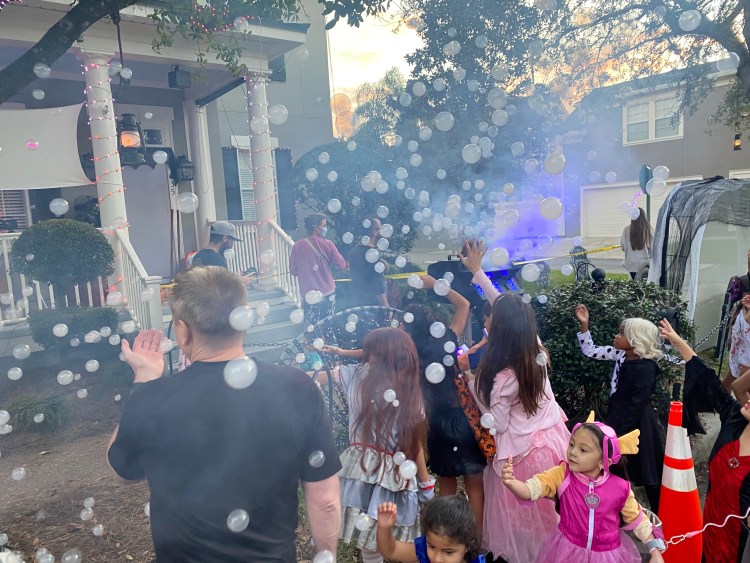
Halloween in Celebration, Florida, 2022
Fort Myers, Florida
We spent much of the latter part of both our trips in Florida. It made sense: the state’s winter weather is a balm for travelers weary of frostbitten landscapes. After leaving the Sunshine State, we knew we’d want to head straight home, making Florida the grand finale of our many stops. Beyond its reputation for tourism, Florida’s real treasure, we had discovered on our first trip, lies in its state parks—some of the best RV campgrounds in the country. The private parks might offer more amenities, but for cost, natural beauty, and a genuine sense of place, Florida’s state parks were unbeatable.
Having had success securing spots in Florida State Parks on our first trip, we decided to plan even more diligently the second time around, nearly succeeding in spending our final two months exclusively within the state park system. This decision not only immersed us in Florida’s natural beauty but also provided a surprising gateway into the state’s history—particularly its environmental story, which, from the perspective of the parks, reveals both resilience and promise.
After two weeks in the winter of Charlottesville, we got back on the road. Our journey back to Florida began at Topsail Hill State Park in the panhandle, a place with an intriguing past as both a seaside resort and a government weapons testing facility. Its history left unexpected remnants, like a relatively short driveway and a café, while its more remote setting gave us a glimpse of what Florida might have felt like before the relentless march of post-war suburban sprawl. Florida, after all, doesn’t feel particularly old—most of its development is a product of the last century, dominated by highways, strip malls, and endless new housing developments.
Florida’s history as an American state is surprisingly brief—it remained a frontier well into the 20th century. Miami, for instance, was only founded in 1896 with a mere fifty residents, and by the 1920s, it had grown to 30,000, still a fledgling city by most standards. Before that, it was largely swampland. A devastating citrus freeze in 1894, which spared only the far southern coast, shifted attention to the region. Henry Flagler, seeing opportunity, extended his railroad southward and built luxurious hotels along the route. A gift of local oranges from a Miami resident persuaded him to keep pushing further—history written in fruit and ambition.
Further south, we lucked into three nights at Fort De Soto Park, a municipal park that mirrored the excellence of the state parks. In Fort Myers, we explored the Edison and Ford Winter Estates, where two titans of American industry had the foresight to escape winter’s bite long before snowbird migration became commonplace. Their estates, with tropical gardens and historic homes, offered a glimpse into Florida’s early allure.
Weather has always been Florida’s double-edged sword. While its winters are mild and inviting, its summers and falls are punctuated by hurricanes. Flagler’s famed Key West rail line was obliterated by the 1935 Labor Day hurricane, a precursor to more modern disasters like Andrew (1992), Irma (2017), Ian (2022), and Milton (2024). We saw the scars of these storms firsthand in Fort Myers and Sanibel Island, stark reminders of nature’s power and Florida’s enduring resilience.
The highlight of our southernmost journey was Curry Hammock State Park in the Keys, where we camped with a breathtaking view of the Gulf right out our back window. The drive through the Keys was longer than anticipated, but every mile carried echoes of Flagler’s ambition—his grand attempt to extend his railroad across the islands, an engineering marvel ultimately undone by hurricanes. Driving that same route, we admired both the beauty and the folly of such a bold endeavor.
Florida’s rapid development has been both a triumph and a challenge. Swamplands were transformed into neighborhoods, crisscrossed with canals and ponds. Yet this growth has also strained the balance between development and preservation. The Everglades, designated a national park in 1947 thanks to the tireless efforts of journalist Marjorie Stoneman Douglas, remains a powerful symbol of this tension—its survival precariously tied to water flows now diverted by concrete and farmland.
Traveling up the East Coast, we stayed at Anastasia State Park near St. Augustine. The campground spot was so tight we weren’t sure we could squeeze in, but it was worth it for a chance to visit the imposing Spanish fort nearby. St. Augustine’s history, dating back to its founding by the Spanish in 1585, tells a brutal story of colonial conflict—a testament to European powers more concerned with thwarting rivals than settling inhospitable swamplands. An ever better campground and fort, in our opinion, is further north at beautiful Fort Clinch State Park.
After visiting twelve of Florida’s state parks, we could confidently say the experience was reliably excellent. The campsites were spacious, screened by native trees and shrubs, and meticulously maintained. The bathhouses were spotless, and the raked sites after every departure were a thoughtful, welcoming touch. But beyond creature comforts, these parks offered lessons in Florida’s rich ecological and historical legacy.
We explored an aquarium at John Pennekamp Coral Reef, marveled at a museum in Myakka River, swam in pristine (and gator-free) spring water at Rainbow Springs, and took a glass-bottom boat ride at Silver Springs. Wildlife encounters became routine—alligators, osprey, manatees, gopher tortoises, sea turtles, and roseate spoonbills. Each park was not just a place to camp, but a living classroom where conservation lessons unfolded naturally.
The parks also offered a variety of enriching experiences: a bluegrass concert at Myakka River, a scrub jay festival at Jonathan Dickinson, an astronomy lecture at Curry Hammock, and a demonstration of an early 19th-century dynamo at Koreshan. For our kids, the parks were more than just open spaces; they were places where imagination thrived, and nature offered endless opportunities for play and discovery.
Through the lens of Florida’s state parks, the state revealed itself as more than just beaches and theme parks. Its real promise lies in the wild beauty that remains, the history that still echoes through its landscapes, and the enduring hope that these places will continue to inspire future generations.

Astoria Hot Springs, Jackson Hole, Wyoming
Key Largo, Florida
Environmental Science is a staple of school curriculums, often presented alongside introductory courses in biology, physics, and chemistry. Unlike those other, more rigidly defined disciplines, environmental science is a kind of catch-all—a melting pot of topics like soil science, oceanography, climate, geology, geography, and others. Its generalist nature makes it more accessible than the head-scratching complexities of physics or the dense, cellular intricacies of biology.
As someone who’s not a physical scientist by training, this makes perfect sense to me. An environmental science textbook feels like an approachable narrative—a story you can pick up at almost any chapter and still follow. By contrast, specialized sciences can quickly leave you in the dust. Meteorology, for instance, is a swirling labyrinth of pressure systems and thermodynamic principles that feels as bewildering as quantum physics. But environmental science is engaging in its focus on understanding issues that affect our world. Topics like global warming, coral reef threats, and the complicated ecosystems of sand dunes invite you to learn about the delicate interplay of nature’s many systems. It’s less about solving equations and more about absorbing the fascinating storylines behind the environment around us. The topic becomes especially pertinent when you’re in Everglades National Park, a biome that has been so profoundly affected by the development of Florida over the past hundred years. Or, when you take a glass bottom boat ride to see the vibrant coral reefs at John Pennekamp State park in Key Largo, only to learn when approaching the reef that almost all of it has died due to rising Gulf of Mexico water temperatures.
When you’re traveling the country, the curriculum practically writes itself. Every new region brings a new ecosystem to explore, and thankfully, the U.S. is blessed with countless public and private organizations dedicated to sharing these stories. Museums, nature reserves, and national parks have invested heavily in educating curious visitors, often with trailside placards and kiosks that make environmental science come alive.
Walk through a preserve, and you’ll find yourself learning about the migratory habits of birds, the life cycles of alligators, or the ancient histories of towering trees. One moment, you’re discovering how air quality has shaped a forest’s growth; the next, you’re reading about the near-vanished American chestnut, now clinging to life through stubborn underground root systems.
After a while, it hits you: all this walking, reading, and observing amounts to a first-rate environmental education. And the fact that you’re not just reading about bison, but standing a few feet away from one—or spotting alligators, sandpipers, ibises, and the occasional coyote—makes it all the more compelling. Seeing nature up close has a way of making you care deeply, even obsessively, about learning more.
Like so many fields, environmental science is best learned on the go. We’re lucky in America to have such an abundance of parks, preserves, and passionate individuals who’ve devoted themselves to teaching the rest of us about the land we call home. With any luck, all that effort will continue to inspire future generations to protect and preserve these wild, wonderful places and lessons that stretch across our country, including those extraordinary worlds at the tip of Florida.

Digging for clams on Pismo Beach, California
Charlottesville, Virginia
Our family RV trips have taken us on countless adventures across the western United States, where we’ve spent an inordinate amount of time looking at rocks. Which is a little odd, considering we don’t spend much time at home in Virginia staring at rocks. Not that there aren’t rocks in Virginia—they’re just a bit harder to find. At home, rocks are often buried beneath a thick blanket of soil, plants, and trees. We focus on different things: the history of our little corner of the world, the wildflowers that bloom in spring, and the trees, which become a living canvas in October, ablaze with yellows, oranges, reds, and browns. But rocks? They stay buried, mostly out of sight, which is probably why we don’t pay much attention to them.
The few places near my house where rocks dare to poke through—often atop mountains, where the land gives up a little of its secrets—make us curious. We stand there, peering over the landscape and wondering what’s going on underneath, but these outcrops are few and far between. In contrast, the geological history of Virginia—and of the East in general—is ancient, complicated, and, frankly, buried beneath layers of history, soil, and time. As you get closer to the coast, forget about it. The rocks vanish entirely, and all you’re left with is sand, which no one stops to ponder for long. It’s just the stuff you cross to get to the ocean, or set up your lawn chair on while you watch the waves.
But out West? The rocks are everywhere. The land is more open, more exposed. The vegetation is sparse, and it’s not hard to see why. The rock formations out there—whether they’re towering cliffs or wind-sculpted spires—are so dramatic they almost seem to dare you to look away. In fact, there are rocks out there that you’ve probably never even heard of, but if they were in Virginia, you can bet they’d be on the cover of every tourist brochure. And with so many rocks on display, you start to wonder, What’s going on here?
Maybe you take a moment to read the placards posted at some of the state parks, and the geological history begins to make a little sense. You might even find yourself getting drawn into it—until your attention drifts away, the information sinking into some part of your brain that only holds onto facts for a couple of hours at best. Mostly, you just want to look. You just want to stand there, gazing at the formations and wondering how they’ve managed to last through millennia.
And then you read something that surprises you: some of the rocks you’re looking at are “only” 10,000 years old, formed during the last Ice Age. Ten thousand years sounds impossibly long—until you stop and think about how long Earth has been around. Our planet is billions of years old. Ten thousand years? Not so much. I’m from Virginia, where the Blue Ridge Mountains are around 500 million years old. Five hundred million. If you write it out, it looks like this: 500,000,000 years. If you’re like me, the difference between 10,000 and 500 million may not seem all that significant, but think of it this way: there are 10,000s in 100,000. And 100,000s in a million. There are 500 millions in 500 million. Or, for an even clearer comparison, think of the difference between winning a $10,000 lottery and a $500 billion jackpot. Oh, now you see it! So, when you hear about rocks that are only 10,000 years old, you start to think, “Okay, that’s not that old.”
The more you pay attention to the geology, the more you realize that what feels like ancient history in human terms—10,000 years, for example—becomes insignificant when compared to the age of rocks. This, of course, has a funny way of reordering your thoughts about time. After all, we’ve only been in our current human form for around 20,000 years or so. So, in geological terms, we’re just a flash in the pan. Not much longer ago than a sneeze. Even more recent is the history of the American West, where explorers like Lewis and Clark reached the Pacific Ocean in 1805. A mere blink of an eye in the grand timeline of Earth. For me, at nearly 60 years old, the history of American exploration feels like it happened in just four of my lifetimes. So, when you put it like that, it doesn’t feel that long ago at all.
What’s really remarkable is how much more recent modern RV travel is compared to what we’re looking at in terms of history. Today, my wife and I can plan a cross-country RV trip, comfortably housing our family of six, staying in well-appointed campgrounds near national parks, and hopping from one iconic destination to the next. We travel in a vehicle that has everything—an RV with a full bathroom, several rooms, plenty of storage, a washer and dryer, and even an electric fireplace. We can check the weather online and adjust our plans in real-time, making sure we avoid bad roads and inconvenient stops. We’re even able to rent our house out while we’re on the road, ensuring that the costs of fuel and campgrounds don’t break the bank. In fact, we’re probably saving money by traveling.
Now, imagine planning that same trip back when I was born in the mid-1960s. It would have been more of a challenge, though still possible. After WWII, the U.S. built its massive interstate highway system, and Americans began to travel further and more frequently. Gas stations popped up everywhere, enticing vacationers with signs promoting the distances to nearby tourist attractions. You could even have AAA plan your route for you. But the logistics would have been much trickier in the 60s. You couldn’t make changes to your itinerary as easily, and RVs were nowhere near as comfortable as they are today. Communication from the road? Well, you’re looking for a payphone, or maybe just forget it. Keeping a job while on the move? That’s not happening. Expensive? Oh, yeah. You could have done it on a budget, of course, but it probably would have been much more of an “adventure” than most families could have tolerated. To do it in the same way we did would have required some deep pockets in the mid-1960’s.
Now let’s go back two of my lifetimes, to the early 1900s, and a cross-country RV trip like we’re doing now was just entirely out of the question. But that doesn’t mean people weren’t trying to explore the country in innovative ways. In 1903, two men—Sewall Crocker and Horatio Nelson Jackson—set off from Washington State to New York, a journey that was at once a promotional stunt for a Winton automobile and a $50 bet. After 63 days of adversity—endless mud, lost supplies, and the constant struggle to find fuel—they made it across the country. They encountered unexpected tolls, had to rely on questionable maps, and were occasionally mistaken for a train when driving along the most ubiquitous roads out there–the railroad tracks. The whole trip cost them $8,000, which would translate to about $250,000 today. It was hardly glamorous, but it did point toward a future of cross-country travel that would eventually become easier for families.
Another notable journey at about this time in 1903 was President Theodore Roosevelt’s “Great Loop Tour.” Roosevelt spent months traveling across the country by train, stopping in 21 states to give speeches about conservation, his “Square Deal,” and good citizenship. He was joined by famed naturalist John Muir in Yosemite and Edgar Burroughs in Yellowstone, riding horseback and taking in the sights of the American West. Of course, Roosevelt’s trip was planned to perfection, with all the amenities that come with being the president. It wasn’t exactly a family RV journey, but it was a precursor to the kinds of travels Americans would come to enjoy.
Go back one more of my lifetimes, and you’re in the 1850s, before the transcontinental railroad, when American settlers were heading west in covered wagons. These were not vacationers; they were people in search of a new life, new land, and new opportunities. They had the money to make the journey but not the comforts we enjoy today. They crossed rivers, battled storms, and faced disease, all while navigating trails that were often treacherous and uncertain. These were long, arduous journeys—ones that, in many ways, make today’s RV road trips seem like a cakewalk.
Then, if we travel further back to the early 19th century, we might find Meriwether Lewis and William Clark, who were sent by President Thomas Jefferson to explore the newly purchased Louisiana Territory and find a route to the Pacific. This famous expedition took two years and cost $50,000 (around $1.2 million in today’s dollars). It was fraught with danger and difficulties—disease, grizzly bears, starvation, and tense encounters with Native American tribes. It’s hard to imagine any family, in an RV or otherwise, attempting a journey like that.
When I think about how much the country has developed in the past 200+ years, I feel an overwhelming sense of gratitude for the opportunity to travel as we do today. Whether it’s the views of the Grand Tetons, the sound of an organ playing Paul McCartney’s “Yesterday” in Portland, or my kids building forts on the beaches of Puget Sound, we are living a life of comfort and adventure that even Teddy Roosevelt couldn’t have imagined. And we’re doing it all on a budget that doesn’t require the resources of the U.S. treasury.
And what about the future? We’ve talked as a family about what RVing might look like for my grandkids. We saw those self-driving taxi cabs in San Francisco, and self-driving RVs of tomorrow seem inevitable. I can’t help but imagine them cruising from campground to campground, automatically hooking up to the campground utilities, and taking us across the country while we sleep. Before bed, you just set the alarm clock and the destination! The scenery will be just as stunning, and perhaps even more so with the comforts of technology. Maybe future generations will be able to look out of big windows, watching the world go by as if they’re riding in a train—but without all the stops. The future of travel may be just as wondrous as the past, but far more effortless. As we look to the future, it’s comforting to think that my great-grandchildren will still be able to experience the same parks I’ve visited—Yellowstone, Yosemite, and Custer State Park. I’ll just be glad I’m not around to hear them say, “Back in my day….”

Florida’s Gulf Coast

John Muir Woods National Monument, Mill Valley, California

Christmas Dinner, Desert Hot Springs, California
Fort Myers, Florida
I began writing about our RV experiences in fits and starts, during the planning stages and later on the road, often squeezed between adventures. But finishing it has taken time—about nine months since we returned home. I’ve always been the sort who makes sense of life’s experiences only after some reflection, and with this trip, it has taken months to fully appreciate and absorb its impact. Hindsight has a funny way of revealing truths you couldn’t quite grasp in the moment.
One of the biggest changes since our return is that we decided to sell our large house and move to a smaller one. This was primarily driven by a new job in a different town, but the experience of living in the RV undoubtedly shaped our perspective. We downsized by about a thousand square feet, and now our three daughters share a bedroom. It’s tighter than what we were used to, but still five and a half times larger than the RV—a veritable mansion by comparison. And the truth is, it feels like plenty of room.
I’d like to think we learned lessons about simplifying and not accumulating so much “stuff,” but if I’m honest, that wisdom remains elusive. We still have a storage unit and a trailer parked in the driveway, both brimming with things we haven’t laid eyes on in months. Apparently, even a year of minimalist living wasn’t enough to completely reform us.
What has stuck with us, though, are the memories. Hardly a day goes by without someone recalling a moment from “the Trip.” We find ourselves reminiscing about where we were a year ago, what we ate, what we saw, and the people we met. The photos spark stories, and even the kids tie moments from the road to lessons they’re learning now in school.
Our family’s shared love of learning, nurtured during those months on the road, continues to flourish. On Sunday evenings, I still dive into the history of science—a tradition that began in our tiny RV dining nook. The kids, to my delight, often ask me to read aloud to them. For the older girls, it’s Sherlock Holmes; for the younger ones, it’s whatever captures their fancy at the moment—be it Diary of a Wimpy Kid or Lemony Snicket. Those hours of RV homeschooling seem to have shaped the way they see us, too. These days, when they spread their books across the dining table to do homework, there’s an air of studiousness that feels familiar, almost like those mornings of learning on the road. They seem to view us as partners in their education, as teachers in a way they might not have if not for the trip.
Of course, the transition back to traditional schooling wasn’t entirely smooth. On their return, the kids initially felt at a deficit, especially when it came to admission testing. But that gap didn’t last long. They quickly caught up and, if anything, seemed to appreciate what they had accomplished outside of the routine. The experiences gained on the road gave them a unique perspective—and a resilience that helped them bridge the gap faster than we could have imagined.
Most importantly, the trip cemented a spirit of curiosity and adventure in our family. Nearly every other weekend, we find ourselves setting off on local explorations, mirroring the way we lived on the road. We strolled along local beaches, canoed down manatee-laden rivers, explored a preserved farm, and delighted in the Naples Zoo. The kids remain curious and engaged, and their wonder and enthusiasm for the world feel like the greatest dividends of our ambitious undertaking.
Our journey to Florida ended with an unexpected twist. A visit with an old friend in Fort Myers led to a job offer I couldn’t refuse. Now, I’m teaching and helping to run a remarkable college prep school there, with a house practically in the view of the local Caloosahatchee River Earthcam! What began as an RV adventure has turned into a new chapter for our family, proving that Florida’s greatest draw isn’t just its weather or attractions, but the possibilities it holds.
If there’s one thing I know for certain, it’s that we’d do it all again in a heartbeat. The road may have been winding, and the challenges plenty, but the rewards—those intangible riches of togetherness, curiosity, and shared experience—continue to unfold, long after the journey has ended.

Ohiopyle State Park, Pennsylvania

Sedona, Arizona
THE END
Florida State Parks (3-18-24)
Our youngest daughter, the extrovert, makes friends everywhere we go on our big RV road trip, and that sometimes leads to conversations with other parents. In this way, my wife met a father from Indiana this past week at a Thousand Trails campground pool south of Miami, who proceeded to try to talk her into joining up. Thousand Trails is a franchise that you can join and pay an upfront fee and then get “free stays” throughout the country, and it’s one of just a few more or less organized chains in an industry characterized mostly by mom and pop operations. We are decidedly not interested, however, as our experience there and at other similar campgrounds had been mediocre. She told me that her first thought was to ask him, “have you been to a Florida State Park?”
Ah, the Florida State Park campgrounds. For the past month and a half, we have been RV camping almost exclusively at Florida State Park campgrounds. We have some authority to make this claim, since we have stayed in 76 different campgrounds of all sorts over the past few years. The demand is also telling. We have seen plenty of vacancies everywhere else we have stayed, but it is rare to see any RV campsite unoccupied in a Florida State Park. On a site we use to book online campsites that have had cancellations, nine out of the top 10 parks are Florida State Parks (and the one left out is a county park in Florida).
The first we visited was Henderson Beach State Park in Destin. Behind our site was a boardwalk across the dunes to the white sand beach, and the shallow waters of the Gulf of Mexico there are stunning in the array of blue and light green shades. From our site, we could not see any other camper, only the native bushes and trees that surrounded ours and every other site in the seaside loop. In the evening, the sun set off to the right side of our view. A few miles down the coast are the high rises and dense suburban development of the city, but it seems a world away at the state park. We didn’t have a full hookup of our utilities there (we had water and electricity but no sewer), but a neat bathhouse was 75 yards away with showers and a coin-operated washer and dryer. There was also a big sink area for dishwashing. Other campers were trading volunteer hours there as hosts in return for their spots, and they were always out and about, and they seemed to be genuinely happy just to be there. We enjoyed riding our bikes down the campground road to another beach area one day, with low speed limits and bike paths that made the experience feel very safe even for our kids (the aforementioned young extrovert was only 6).
We thought maybe this was just a unique experience, as many states’ park quality seems to vary from place to place, but we soon found that this was pretty much typical in Florida. We have now stayed at 12 Florida State Parks, and the quality has been consistent. The spaces are ideal–big and well screened with native trees and shrubs growing up around the sites. They are well kept. The bathhouses are neat and clean, and the spaces are raked after every user departs, a very nice touch. They also have interesting ecological and historical features, including beaches, historic homes, rivers, swimming springs, museums, and a variety of habitats for the parks’ abundant wildlife. We have checked out an aquarium at John Pennekamp Coral Reef, visited an excellent museum at Myakka River, and taken a glass bottom boat ride at Silver Springs. We have seen alligators, osprey, manatees, gopher tortoises, sea turtles, and roseate spoonbills. There are conservation-minded lessons to be learned all around, on kiosks and along the pathways. We also felt fortunate to attend all manner of events during our stays, including a bluegrass concert in Myakka River, a scrubjay festival in Jonathan Dickinson, an astronomy lecture in Curry Hammock, and an early nineteenth century dynamo (electric power generator) demonstration at Koreshan. Our kids also prefer having plenty of space to play around our RV and the variety of habitats and imaginative play that can come about as a result.
Every one of our stays in Florida state parks has come as a result of cancellations. You can try to book a spot on the website when they first come available, 11 months prior to your stay, beginning at 8 a.m. each morning. However, I had no luck in securing anything that way. Instead, I signed up at Wandering Labs, an online website, which checks the Florida State Parks site for cancellations every minute or so and informs you, by text and email, of any open spots. When you get a notice, you have to drop everything you’re doing and scurry to log in and provide information before hitting “reserve.” I was successful about one out of every three times I tried as the sites are generally gone within a few minutes. I think there are plenty of us trying–the website will tell you how many people are logged in and checking on a particular campsite that has a reservation, and I don’t think I ever got a site that someone else wasn’t watching as well (and I once saw one available that more than 60 people who were watching). But you can probably make it work with persistence and fast fingers.
Oh, and one last benefit–the cost. While we spent $120 a night for 4 nights at the Thousand Trails,but we never spent more than $42 a night at a Florida State Park. So, no, we won’t be signing up for Thousand Trails.

Our Kids and Others Sworn in as Junior Rangers, Jonathan Dickinson State Park
Remembering Our Travels
I have been on what I will surely always remember as the journey of a lifetime this past year. My family is nearing the end of a 7-month RV trip across the country and back. My wife and I have four kids, 3 girls and a boy, ranging in age from 8 to 13. We have had some experience with RVs in the past, and we had long imagined taking a longer family trip like this one when we came to the point in their lives a few years ago when high school started to loom for the oldest, and we figured it was now or never.
The trip has been a grand adventure. We have been to 22 states and driven over 20,000 miles. We have stayed in 40+ campgrounds, and have gotten so used to moving that we can load up and go or arrive and set up in about a half hour and without much thinking about what we’re doing. We have visited all the national parks along our route (a dozen?) and many more state and local parks, museums, libraries, playgrounds, and bookstores, not to mention yarn and record shops, reflecting the particular interests of our kids.
We’ve done so much that we’ve been having a hard time keeping track of it all. We feel like entertainers going from town to town with the same act who can’t really remember one place or face from another. “Where did we see those gopher tortoises again?” “Where were we on Louise’s birthday again?” “Where were we when we had the Indian food?” Even, “where we last night again?” So we review. “Let’s try to remember the order of campgrounds we visited in Oregon.” “Okay, let’s name all the big mammals we’ve seen and where.” “What do you think was the farthest northern point on our trip?” “Everybody, let’s name our favorite beach so far.”
Of course, it’s best to try to be aware of the moments we are in. That’s probably the best way to remember things and to appreciate where we are and what we are doing. That’s also probably best for us in our roles as parents. Sometimes it’s hard not to get distracted, particularly by thinking about what’s coming next. I have a big season ahead at our summer camp, and I have some plans in the works that I think about. Honestly, I worry about plans as much as I think about them, and I’m not sure that’s doing me or my family any good.
So what have I learned on our big trip? Every town is the same to some extent. It’s just one big country, end to end, and it doesn’t vary much. The topography changes, yes, but we’ve settled it all in much the same way. I’ve traveled a fair amount outside the country too, and it is all different from, say, Costa Rica or China. The roads are very good practically everywhere (especially when you’re driving an RV and trying to stick to the main highways). It’s usually pretty easy to find good camping spots, groceries or hardware items, or even an Amazon drop box if you have to replace a hard-to-find refrigerator vent cover that you broke off when you ran into a tree limb in a state park. The people we come across in the campgrounds, either retired or on vacation, have been kind and positive almost universally, as they smile and they pass on their walks or their bikes. There are a lot of good people in our country. But I also didn’t know how different every town would be. They all have their own character. There are places that seem to be growing and thriving, like much of Utah or coastal Florida, while others are in decline, like western Washington or Nebraska. I supposed I’d have thought towns in the same state would be more alike than they are, but only a few hours separated coastal Astoria, Oregon from Bend, Oregon and the two towns couldn’t have been much different. Home prices were so high in northern and southern California and in Bozeman or Utah, but it was easy to imagine affording a place in most other areas.
As I write, we are happily situated in a Florida state park. Our views out the window, which are always best at state parks, feature native cabbage palms, sea grape, gumbo limbo, and marsh grasses. We take walks around the campgrounds after dinner and see everyone’s setup (trailers, fifth wheels, vans, and tents). In this campground, there are several glamping tents with string lights creating a cozy space and, in getting a peek into someone’s tent, we see a tidy space with a comfy bed and colorful rugs atop a sturdy wooden base. My wife says, “oh, that would be a fun place to stay,” and we talk about coming back some day, just the two of us, after the kids are grown. We would have one of these mobile little Sprinter vans, and enjoy our days riding bikes and reading books, just like most others are doing here in the park.
But we always realize pretty quickly at moments like these that we’re going to spend much of that future time just reminiscing about this moment, right now, and say things like, “remember when we took the kids to the Scrubjay Festival in Florida?” “And remember those gopher tortoises we saw riding our bikes.” Or, “where were we that time we were biking and saw that moose running along the side of the road?” So best to do all we can to be here now.

Eating Pie on Pi Day, Coconut Grove
RV trips of the past (and future)
Pismo Beach, California, December 17th, 2023 – On our family RV trips, we have spent a great deal of time in the west looking at rocks, which is unusual because we don’t really spend a lot of time at home in Virginia doing this. There is a good reason–we can’t see the rocks in Virginia. At home, they’re covered by many layers of soil, plants, and trees. We focus on other things there, such as the history, or the flowers, or the trees. The trees are the big subject in October when they’re all turning dramatic shades of yellow, orange, red, and brown. But, really, who knows, or pays attention, to what’s underneath that? In those rare places near my home where we see rocks on the tops of mountains, we want to know what is going on. But there just don’t seem to be that many rocks. Moreover, the geological history of Virginia and the east coast generally, buried mostly well under the surface, is much older and more complicated. As you get closer to the coast, there are hardly any rocks. It’s just sand, and no one really looks at the sand for long and wonders how it came about. They mostly just bound across it to get to the ocean or set up their lawn chairs and umbrella there to gaze upon the waves.
But out west, you see the rocks. There’s not as many plants or trees. It’s clear and dry, and the rock features are usually much more obvious. If you live there or have ever visited there, you know this. The rock formations are stunning. There are even once you’ve surely never heard of that, if they were in Virginia, would grace the covers of all the state’s tourism flyers. With so many rocks out west, you can’t help but wonder what’s going on. Maybe you read about their history and it makes a lot of sense and you want to understand it more fully. More likely, you browse a placard or two at the state park, and you go, “huh, well how about that,” and the information passes quickly through some region in your brain where thoughts are maintained for an hour or two at best. Mostly, you just want to look. Gaze. Behold.
If you pay any sustained attention to the information presented at the roadside markers, you learn that maybe they’re not that old. Sometimes, according to the prose of the geologists, they’re “only” 10,000 years old, going back to the last Ice Age. If that sounds like a long time ago to you like it does to me when I first hear it, that’s because you haven’t taken a geology class. I haven’t taken a geology class either, but when I give it a moment’s thought and reflect that Earth’s age is counted in the billions, I invariably think, “oh yeah, that’s not a long time ago.” The Blue Ridge Mountains near my hometown are 500 million years old. If I write that out, it’s 500,000,000 years old. On first glance, 500 million maybe doesn’t look all that different from 10,000. Sure, it starts with a 5, so that perhaps even makes it look bigger. But think about it this way. There are 10 10,000s in 100,000. There are 10 100,000s in 1,000,000. And there are 500 millions in 500 million. Or put another way, imagine the difference between a lottery payday of $10,000 and another of $500 billion. “Oh, now I see!” So, in the life of rocks, 10,000 years ago is indeed not that long ago.
If you manage to change your assumptions about how long ago is “a long time ago,” as you might do looking at rock formation after rock formation, human history is suddenly “not that long ago.” We humans, in our current form, more or less, have been around for 20,000 years, again, more or less. To geologists, that’s “not that long ago.” Even more recent has been the American exploration of the west. Lewis and Clark reached the Pacific Ocean in 1805–really not that long ago at all. I am approaching 60 years old in a few years, so the history of Americans traveling to the west is just four of my lifetimes long. Again, not that long ago at all.
Modern RVing has evolved to the point that my wife and I can easily and with a reasonable amount of resources plan a months-long RV trip with our family that takes in national parks and historic places across the US and Canada. We can stay practically anywhere, and if we are careful, at nicely appointed parks near interesting attractions and with places for our kids to play outside. We generally stay in campgrounds with full utilities (electric, water, sewer), in an RV that comfortably sleeps 6 with a full bathroom, several separate rooms, propane gas, wifi, plenty of space for storage, a washer and dryer, and even an electric fireplace. We watch the weather on online sources in order to ensure moving only when we can pass easily across our country’s excellent network of roads, careful to avoid the smaller roads when we are moving the trailer. If we need to make a change in our plans, we send cancellation emails and find a new place to stay. As long as we’re not traveling on weekends in the summer or to Florida’s coasts, we have little trouble. We have even rented our home out during our trip, so the added costs of fuel and campgrounds has not even set us back financially. Moneywise, we will probably do better on the road than if we were at home.
If my family had planned such a trip when I was born in the mid-60’s, the trip would have been substantially more difficult. Doable, but perhaps unrealistic. There were certainly tow vehicles and trailers or motorhomes that would have accommodated us back then. After WWII, the U.S. built its massive interstate highway network, and Americans began to car vacation much more regularly and to more far off destinations. Gas stations promoted the travel, with signs indicating the distance to all sorts of nearby vacation sites. You could even have good ole’ AAA plan your vacation. Campgrounds had also been around a long time, and both the national park spaces and the private campgrounds grew dramatically after the war. It probably would have been an odd pursuit for a family back then, but a trip around the country in an RV was not out of the question. Still, it would have been rough. I can only imagine the challenges of planning it by telephone, making changes in the itinerary along the way, dealing with breakdowns, and repairing the trailer. It also would have been much more costly, and probably unrealistic for a family like mine. Keeping in touch with home in the way we have or managing a job from the road would have been impossible.
Now, let’s go back two of my lifetimes, to the early 20th Century. A trip like we are taking now was entirely unrealistic, and several well known turn-of-the-century journeys illustrate the point. In 1903, two men, Sewall Crocker and Horatio Nelson Jackson, started from Washington State on a cross-country trip to New York. The story goes that one had made a $50 bet that he could do it, though the more important motivator was perhaps to promote a Winton automobile. They received a great deal of attention for their adventure, particularly after a few months of misadventures were recounted in eastern newspapers. It took them 63 days to make the journey, the hardest parts of which came first in the sparsely settled West. Their car had remarkably few failures, according to the newspaper accounts anyway. The adventurers were eager to recount the difficulties of the roads, pulling themselves out of muddy holes repeatedly, or remembering how they’d lost their cooking equipment and nearly died of starvation. They struggled to find gas and oil at times, and they had neither GPS nor a reliable map. At times, they drove across fields with no sign of a road. They even had to pay tolls to some enterprising landowners. Families moving to the west in wagons were often shocked by the sight of their automobile, particularly when they drove along the edge of railroad tracks and were sometimes mistaken for a train engine. They claimed to be taking their time so as to take in the sights, but they were mostly just trying to get it done. The trip was said to have cost them $8,000, or about a $250,000 in modern dollars. It wasn’t pretty, but it pointed to the future.
Another famous trip took place in 1903 that perhaps looked a bit more like a modern RV adventure: President Teddy Roosevelt’s “Great Loop Tour.” Soon after becoming president, he set out on the presidential train and crossed the country, taking in 21 states from April through June. His was, of course, a more well-planned journey, featuring regular speeches from the back of the train trumpeting conservation, his “square deal” economic plan, and elements of good citizenship. He took weeks off the train to ride by horseback through Wyoming, and to see the sights in Yellowstone with famed naturalist Edgar Burroughts and in Yosemite with the extraordinary John Muir. Roosevelt traveled in style with all the trappings and conveniences afforded by being the first citizen of the United States and probably the country’s most famous man. It was a full and effective trip, with plenty of modern conveniences. Of course, the cost of it was surely astronomical, but it puts a modern trip in perspective. To take the sort of trip we are on now with many of its conveniences a hundred years ago would have been not by truck and trailer, but by train, and it would have cost a fortune.
If we go back one more lifetime, we’re in the 1850’s, before the transcontinental railroad, and at the time when American settlers were moving west in covered wagons or prairie schooners. No one was taking a cross-country vacation then, though they were packing up everything they could take on a summer’s-long, thousands-of-miles journey in search of a new farm and greater opportunities. They tended to be middle-class Americans who had the enough resources to finance the journey, and who were just ambitious and looking for something better in a new territory. Many made their way to St. Louis, maybe fully prepared or maybe with a pocketful of cash to buy oxen or mules, a wagon, and all their supplies. They banded together with others for support and security, and they set out, riding or more likely walking behind the rig, and slowly making progress. The infamous hazards included the river crossings, storms, and diseases, such as cholera, that might end a person’s life in a day. Though many feared the Native Americans whose territory they were crossing, that was probably the least of their worries. If you’re doing a cross-country tour nowadays, there are many opportunities to visit historic sites associated with this era along the way (we have visited the the Oregon Trail Museum in Baker City, Oregon and the Laura Ingalls Wilder Museum in Walnut Grove, Minnesota), perhaps reminding your children, who are whining for another snack, about the fact that these mid-eighteenth century pioneer children probably walked a couple of thousand miles to get to their western homes.
The last journey back in this narrative takes us to the early nineteenth century, when President Thomas Jefferson had the opportunity to buy the Louisiana Territory for a cool 15 million bucks, and then sent his private secretary Meriwether Lewis and his experienced friend William Clark (and a crew of 30 men, 1 Native American woman, and one infant) on a first-time journey for any individual of European descent across the North American continent to the Pacific Ocean. That famous trip took two years and cost the country about $50,000 (perhaps $1.2 million in modern inflation-adjusted dollars). It wouldn’t have been completed if not for the cooperation of many of the Native American tribes along the way, including especially the Mandan, Shoshone, and Clatsop. Though considered a remarkably successful trip in American history, it was still fraught with danger and extraordinary struggles, including tense encounters with the Sioux tribes along the Mississippi, arduous journeys across the Rockies, meetings with grizzly bears, and periods of starvation. Needless to say, no family of 6 was taking an RV journey back in that day!
When I reflect on how much the country has developed in the past 200+ years, it makes me very grateful for this opportunity to see so much and live so well in 2023–the view of the Grand Tetons along the Grand Tetons Pathway Bike Trail, roller skating in Portland Oaks Park while listening to an organist’s version of the Paul McCartney’s “Yesterday,” walking across the mile-wide sand at Grayland Beach on Washington’s Pacific Coast, feeling the wind behind a beautiful old biplane starting up on a runway along the Ohio River in West Virginia, or watching my kids building forts on Puget Sound beaches through the windows of my RV, with ferries and tankers trolling off in the distance. We feel just as lucky as Teddy Roosevelt probably did a hundred years ago, but at an affordable price, plus we don’t have to make all those speeches!
I can’t end this narrative without giving a little thought to what this trip might look like another lifetime down the road, if my kids are taking their kids on grandkids on the same sort of grand American tour. Assuming we haven’t blown the place up by then or otherwise destroyed ourselves and all our wild places, it’s not hard to imagine what that might look like. We discussed this as a family, and as we saw self-driving cars in person for the first time on our recent visit to San Francisco, the RVs of the future will surely drive themselves. They might look quite different, as a “driver’s seat” will be unnecessary. Perhaps they are just attractive, small, longhouses. It seems like the driverless car future will be less dangerous for passengers (think airline quality safety here), so we are probably more likely to dispense with the need for seat belts, and have the opportunity to just ride in the trailer or “house” while moving. We might program the nimble homes to relocate from campground to campground on their own, and since the traffic would be less taxing overnight, maybe we plan to sleep on the drive from, say, Yellowstone to Badlands. Or maybe we want to see the countryside along the way, so we just look out the big windows going down the interstate, as if we’re in our train car, but without all the stops. It’s not hard to imagine our AI computers making all the plans for us either. The task of hooking up to water, sewer, and electricity might be simplified with a universal hookup that works automatically. The moving house of the future settles slowly down into a spot, with all those utilities turning themselves on or off and working seamlessly. Maybe we have solar panels on the roof which make the electric hookup unnecessary anyway. Perhaps there’s even a little landscaping around your campground space, not to mention the universal picnic table and a few shade trees. Many of the destinations will have changed, but it’s comforting to assume that even my great grandchildren will likely still be able to see the same things I have in the public parks–Yellowstone, Yosemite, the Everglades, South Dakota’s Custer State Park, or Oregon’s Silver Falls State Park. My children might then be tempted to ask their grandchildren, “do you know how easy you’ve got it, Sonny? Why, back in my day….”

Watching Puget Sound Over Dinner at Flagler State Park, Washington
Trip #2, 2023
In 2021, our family of 6 went on a 2½ month road trip in an RV. My wife and I love to travel, and though we had made a modest trip or two per year with our 4 younger kids (aged 5-10 in 2021), we had never gone anywhere for more than a week since we’d had kids and generally within a few hours of home. But then the pandemic came, threw everything upside down, and as we sat at home much more than we had in the past, we began to think about a bigger trip. After a few months of pondering, we started looking for a travel trailer and soon moved one into the driveway for a renovation. The trip that followed was the most meaningful and memorable thing we have yet done as a family. After we returned, we sold the RV and everything in it, and let some time pass to decide whether we wanted to do it again. And sure enough, all 6 of us found that we were hooked and eager to go again, and my wife and I decided to make that happen before the kids changed their minds!
This time, our ambition is bigger. We are going away for 7 months and taking our kids all the way from Virginia to the Pacific, and wandering relatively lazily down the West Coast from Washington to California before exploring the southern half of the country and Florida. So we are starting over again, buying the RV, making reservations, and planning our lives around being away from home for more than half a year. We expect it will be another big adventure and one that we will reflect back on for the rest of our lives.
RVs are small homes on wheels, and they are not particularly well built. They can’t be. If you’re going to be traveling much at all with the thing, then it can’t be so heavy that you can’t pull it. As a result, they’re built with lightweight materials. If you have the occasion to start taking one apart as I have, you see evidence of this throughout. They’re mass produced and somewhat overly complicated by having too many systems in one vehicle. They are notorious for having multiple problems, even when just driven off the new RV lot. Our first one was twelve years old when we bought it, and it was, of course, no different.
An RV will have problems when you get it, problems you create, and problems that you can’t anticipate. Our first RV, a 2009 KZ Spree Bunkhouse that we sometimes called “Harvey” (Harvey the RV), had the problems we knew about–mostly the water damage that had slightly delaminated its exterior walls in two places. We created problems for ourselves by not fully testing our plumbing work from replacing two countertops and sinks. The problem that we didn’t anticipate was our biggest test.
After two weeks into our trip, we were feeling pretty good about ourselves. We had driven away from home with no experience in camping in our trailer, and we were right on schedule. We had enjoyed just about everything about our first few weeks of camping. I had managed to work out the plumbing issue I had created by visiting
When you are out on the road, you should anticipate that you’re going to have some unanticipated problems. Our most notable one so far happened a couple of weeks into our first trip when one of the trailer tires blew out.
We were feeling really good about ourselves when it happened. We were well down the road of our first big trip and had managed to sort through lots of little issues. We had stayed in six different places and had gotten used to all the routines of setting up camp and then breaking everything down and moving it all down the road.
We were driving through central Wisconsin on the interstate at about 3 in the afternoon, and perhaps a half hour from our campsite when we heard a loud pop. “What was that?” we thought. It sounded like we’d had a blowout, and indeed, we had lost a tire on the right side of the trailer. The trailer had dual tires on each side, so the vehicle was still rolling, but we could not drive on just one on that side for long. Fortunately, there was an exit just ahead of us and we found a big open and flat parking lot there beside a storage facility. That was about all there was at the exit. The tires were relatively new when we bought the trailer, but I understand that blowouts on trailer tires are not uncommon, and I didn’t really know the history of our used trailer thoroughly.
Our 4 kids were then between the ages of 5 and 10, and we really hadn’t traveled that much as a family over the past decade. We had taken a handful of trips, but it generally seemed like the benefits of travel were not worth the costs for all of us. The kids just weren’t very happy stuck in the car for long periods of time. Air travel always seemed very expensive. We got in the car to visit family mostly, and wondered whether it was worth all the trouble to go anywhere else.
So we had tried to think ahead of time about what would keep the kids occupied and engaged while we were driving down the road. And part of that was keeping on a schedule and getting to the next campground so that they could explore and run around a bit. It had been going well so far. The flat tire was mostly difficult for us because it broke this pleasant and contented routine that we were in.
We had a spare for the trailer, and so I began to jack up the trailer to change the tire. It seemed like it would go easily enough and, if we could just keep our kids happy and moderate their anxiety about this, that we would be back on the road in no time. I had two problems in fixing the tire, however. First, the trailer’s tire iron was a flimsy and almost completely useless tool. I suppose it was another of those things where the builder tried to cut the weight of the vehicle, but in this case, it was not a good idea. While I managed to make it work, I then found that one of the lug bolts on the wheel had been stripped. I tried and tried, but it was no use. I didn’t have a tool to remove the tire.
Meanwhile, my wife had called Triple A, and a recorded message told us that someone would be in touch within 90 minutes. I hadn’t thought we would need the help initially, but after spending a half hour or so on removing the tire, I realized that we were indeed going to need a backup plan. Our kids were okay for a while, but it seemed increasingly like we needed to do something for them. They wanted to know, as kids do, exactly what was going to happen, and we hadn’t figured that out yet. They were getting hungry, bored, curious, and anxious. So we made the decision to pull what we might need out of the trailer, unhook, drive to the nearest town and find a hotel. Meredith would stay with the kids while I dealt with the trailer. It was a bummer, because we’d been so close to our next campground. After it was over, however, I realized that there were many worse places on the trip where that tire could have blown out–West Texas, for example. If it had happened five minutes after we’d started the trip, we might have never left town.
So the next hour was spent in getting the family settled in a hotel in Wasau, Wisconsin, where they ordered pizza and watched television. Some might have remembered the evening fondly while others thought it was the worst single evening of the whole trip.
While it turned out that central Wisconsin was probably a good place to have a breakdown, it was not a good time to have a problem. It turns out that the towing company employees of central Wisconsin didn’t want to work at that hour as they presumably had places to go or maybe football games to watch. When the 90 minutes had expired and the AAA message timer clicked down to zero, it became clear that no one was coming from that source either. I decided to drive back out and pick up the trailer and drive it into Wasauy and try to find someone to help me to change the tires. As we were not hopeful that we’d find any shop open on Sunday morning, we thought we might be there for a while. But remarkably, there were several open, and while most did not stock the tire we needed, there was a Fleet Farm that had them. In fact, they were in stock and on wheels, and their tire shop was open on Sunday morning. Over the phone, I was told that they were too busy to help me that day, but I thought that maybe they’d help out if I just drove over there and parked right out front. I decided to change all four tires while I had the chance and found them on the shelf in the back of the big box store. I put the enormous tires in a couple of shopping carts, pulled one while pushing the other, checked out, and began jacking up the trailer. The mechanics in the shop gave me a tool for the stripped bolts, and after about an hour, I had replaced all four tires. I drove away at about 10 a.m. Sunday morning, and went to get Meredith and the kids. We were so happy to be all back together in our rolling home, sweet, home.
Over Spring Break, 2023, I sponsored a trip to Costa Rica for many of the older campers and counselors at Field Camp. I have visited the country ten times now, and 8 of those were school-related trips. After my first three trips there, a native Costa Rican family from Charlottesville with ties to camp moved back to the country, and they have since welcomed us to their hometown. There were 21 of us on this trip, and we had a blissful week down in Paradise.
Costa Rica
Costa Rica is bordered on the northwest by Nicaragua, on the southwest by Panama, and on either side by the Gulf of Mexico and the Pacific Ocean. The coasts are flat and hot, but the interior plateau is a plateau formed over eons by (still active) volcanoes, and the weather is a bit milder and with constant winds. I have always gone in the North American winters and springs when the weather there is ideal–sunny and dry with highs in the 80s in the interior and lows in the 60s. Though most tourists to Costa Rica head to the Pacific Coast somewhere, we stay in the central part of the country just outside the capital of San Jose in Heredia. I have now stayed a half dozen times at the same bed and breakfast there, and we make day trips in rented vans to see the sights around San Jose and Heredia as well as the beaches and the mountains. The b&b is in a nice little neighborhood, and we take a 20-minute walk to the local town square to play in the park and check out the shops. There are plenty of restaurants there to keep us fed, and nearby is everything else we might need during our stay. We get breakfast at the b&b most mornings (rice and beans, sausage, eggs, plantains, fresh fruit, and coffee), and we eat together one other time each day at a restaurant along the way of our travels. I can’t recall ever having anything less than a satisfying meal there. I usually order casado (the “home” meal of rice and beans, plantains, salad, cheese, and choice of meat).
This camp trip featured a number of old time camp faces (Pablo, Ruben, Oliver, Ivy, Andy, and me), as well as many from this latest generation. We made the usual day trips there to the Baldi Hot Springs near La Fortuna and Arenal Volcano, to Manuel Antonio National Park on the Pacific coast near Quepos, and to La Isla Tortuga across the bay from Puntarenas. We visited the capitol area and Pablo showed us the newly built Congress building (which looked Soviet in its brutal construction), and we did our obligatory stop at Britt Coffee. The group of campers and counselors were wonderful travel companions. It was Holy Week there, maybe not the best time to visit due given bigger crowds everywhere, but we would do it again.
Mark Twain wrote “travel is fatal to prejudice, bigotry, and narrow-mindedness, and many of our people need it sorely on these accounts.” Though written 150 years ago, it’s still true. Costa Rica is a lovely place with kind and welcoming people as a rule. I suppose I am tempted to move there, particularly as I sense (and rationally know) it to be a safer place than my home. I was certainly under the impression as a teenager that the rest of the world outside my home was far scarier and more dangerous than what I knew, and it took a while to learn that I had it wrong all along. I look forward to many more trips, often with a crowd of campers in tow, to this wonderful little country in years to come.

Ivy, Pablo, Andy, and Oliver in San Jose

The Golden Hour ferrying back from La Isla Tortuga to Puntarenas

The view from our b&b, across the rooftops and toward the mountains

Our group on our last day, and not too badly burned (except Ivy)
Ireland
Meredith and I went to Ireland for a week in September, the first time we’d been away from our kids for more than a night in 12 years. She planned almost all of it while I was still absorbed in camp, but one night she told me about a natural oceanside swimming pool on an Irish island and showed me a photo. I hadn’t had much preference about anything to that point other than that we stay at least a night at the Lake Hotel in Killarney where I had once taken a group of students, but I perked at the thought of seeing this pool. “Let’s do that.” It’s called the Wormhole, and it’s situated on the western edge of Ireland on an island called Inish Mor. It’s not easy to find, but you can locate it on google, and its rectangular shape is easy to make out on the map. Its shape is strangely perfect, and though I can’t find any information suggesting anything other than that it is a natural pool, it’s just too perfectly squared off to be naturally formed. I had thought I would want to jump in when we got there, and I might have if it had been calm that day. But it is clearly affected by the tide and wave action, and it was rising and falling too quickly when we there to take that risk. I wait for a week for the Blue Ridge Pool to fill up, but this one was rising 10 feet in ten seconds. Just let me know if you get to see it, and if you jump in, or think better of it.

Summer, 2022
This past summer was just blissful. After two years of instituting draconian Covid rules, it was such a relief to spend so little time worrying about a virus this summer. In the first summer of Covid, our camp opened on the first day we were allowed by the state government, with a strict set of rules. We carried them out religiously all summer, keeping our masks on and maintaining 6-foot distances between ourselves. Our camp was the first place that many of us experimented with the new rules, and we came to understand that we were taking it all more seriously than other area organizations. We had no idea how necessary it was, but, like everyone else, we knew that it was a deadly disease and we were doing our part not to spread it while trying to give our campers a normal summer. As best we can tell, no one had Covid in our camp during 2020. In the second summer of Covid, we moderated all the rules significantly, but still kept masks on and at a distance. We had two cases that we knew of in camp, but it didn’t seem to spread from these two to anyone else. In all, it wasn’t an issue for two summers. In the third summer, we let down our guard completely as all our population had been given the opportunity to vaccinate (and most of them had). Almost everyone else had stopped trying too, and as a result, Covid was abundant. We had perhaps 25 cases in camp, and another 25 who didn’t come due to a positive test or exposure. With so many cases walking into camp, I would have thought that perhaps it would spread in camp. But our best guess is that 2 or 3 cases may have come from camp contact, although even those campers could well have caught it elsewhere. So after 3 summers, we finally had enough test cases walking among us to know that, indeed, virus spread in an all-outdoors setting is pretty rare. I don’t regret having been so careful for the first two summers, but in the end, I am not sure that it made any difference whatsoever in our outdoors circumstances.
The best day of camp this summer was a rainy Thursday night. There had been some small chance of rain in the forecast, but we had a steady downpour in the early evening and overnight that did not much let up. On the radar screen, about the only rain anywhere around was right over us. Some of the campers don’t like the rain and it will lead to complaining and misery. It also gets us out of our well-worn routine, and can add all sorts of challenges to the evening. We had started playing Capture-the Flag before it started to rain, and though it began to pour, there was no lightning and the game went on unabated. There was too much rain for a campfire, so we handed out the s’mores ingredients at the Pavilion and the kids were perfectly happy to eat “raw” marshmallows and chocolate. We were far enough into camp at that point that many had song the camp songs a few times, so we did our music routine as usual under the Pavilion’s steel roof. It seemed to only rain harder while we we there, and it was so noisy that we had to raise all our voices in song. After a while, it felt like we were practically yelling out all the songs, and I had never heard it so loud at camp.

Florida!
Over Spring Break 2022, I took an older camp group including younger counselors to Florida. We had been getting together throughout the year to go on adventures, and we had anticipated spending a week in Costa Rica. Covid changed our plans, however, and we decided to change our destination to the Sunshine State. The 16 of us drove down to the Fernandina Beach area, just across the state line from Georgia, and spent the first half of the trip in the beautiful Fort Clinch State Park.
The designers of America’s state parks generally make a wonderful effort on behalf of the RV crowd (of which I am one). The same cannot be said for group campgrounds meant for young people. They are typically set many miles away from the older RV crowd campgrounds, and the kids are forbidden from using the better camp facilities usually found near the big hulking vehicles. Instead, the kids usually get a pit toilet and maybe, just maybe, some running water. Sorry, kids, but you don’t vote!
Fort Clinch State Park, however, provided a well equipped group campground with a real bathhouse. Yes, the group campground was situated a couple of miles down a sand road that veered off the main paved roads, but that didn’t matter to us. We were in heaven, off by ourselves, and we felt like we had the place to ourselves. Okay, it would have been better to be out by the beach like the RVs were, but again, I digress.
Just after arrival, we went straight to the beach. There was a restaurant nearby with lots of TVs showing the March Madness basketball games, and it didn’t look like they would be too picky about a crowd of kids who were maybe just in the ocean coming in. So we had pizzas and watched the first semifinal game, and though we were exhausted, it was all really fun. We had been up since the wee hours of the morning, perhaps 20 hours at that point. Everyone went to sleep quickly back at camp and slept in. I slept till 815, a record for me probably for the last 20 years. We had eggs and bacon and fruit for breakfast, then went to Target to get some things, and spent the afternoon on the beach. The kids divided up into two teams and played Survivor games on the beach, and a few of us even got in a game of croquet. For dinner we had spaghetti, sausage, and salad.
The best day of the whole trip might have been the second one. We had pancakes for breakfast, and then after another run to the shop for assorted snacks and sundries, we went to the fort at the state park. It is a beautiful site with nice views of the ocean and river. We then spent some more time at the beach, and one of the games the previous day inspired an afternoon filled with shell hunting. We rented beach cruisers for everyone and rode around the park in the late afternoon—biking in parks where the cars go so slow and where every road is covered with a tree canopy was pretty heavenly. We had hot dogs and pasta and brussel sprouts for dinner, and most spent the evening watching UNC beating Kansas on a setup we put together here in our humble camp.


Road Trip Journal, Back in Charlottesville, 11-11-21
We arrived back from our two-month journey earlier this week. After all that time inhabiting 300 s.f., our house seems immense. Instead of turning and taking one step to get to the fridge, I walk across the room. Our bedrooms seem cavernous. We have so much stuff. The children are off playing now and we can’t even hear them. Our life was so dramatically different during this past season, and though it was probably not sustainable just the way we did it over the long term, I enjoyed it immensely. As I look back on it and make the transition back to my normal life, I mostly remember the virtues of the experience. First, we saw so much of the country–people, landscapes, wildlife, parks, and cities. We saw bald eagles, bowling alleys, zoos, streams, mesas and buttes, lizards, strip malls, beach rocks, schoolies, the New Mexico statehouse, adobe houses, and so on. It was quite an education for all of us and an extraordinary life experience. Second, we were closer as a family. This might have been a struggle if we didn’t get along, and the tensions in the family were certainly exacerbated by the close proximity. But on the whole, it forced us all to spend more time together, and we all know one another better than we ever have. Third, it represented something that our family has not really had in the past: a shared bonding experience. There were moments of adversity on the trip, when our tire blew out and when a dead battery forced us to change plans for a day. We two parents had full-time chances to be parents and to educate and guide our children through the days, weeks, and months. It gave us all the opportunity to persevere, and we did so, and can be proud of what we all accomplished and eager to take on new challenges in the future. We all breathed a sigh of relief once we’d returned to our familiar home, with its relatively lavish bathrooms and nearby friends, but I think we will long to be back together in tighter quarters soon enough, with a new destination in mind for the coming week, and adventures on the road ahead.


Road Trip Journal, Santa Fe, New Mexico, 10-13-21
Our trip continues to move along happily according to plan. We are now in Santa Fe, having crossed mountains just east of us over the past week. From Scottsbluff, we moved to Denver and spent several days there with friends Ivy Geilker and Aidan Folger. Then we drove south to Monument for one night and then to Angel Fire, New Mexico, in the mountains west of Taos. We chose the campsite in Angel Fire from the map without fully appreciating its elevation at 8,430 feet. The high mountain valley was beautiful, and the campground was the newest and most comfy we have yet visited. But it was also very cold at night, with our second night getting down to the mid-20’s. We had planned the trip with the idea that we would not experience freezing temperatures, so this was a surprise. However, we made it through a cold night. We looked at the temperature for Angel Fire last night and it was in the 20’s again with snow showers all night, so we are certainly glad to have gotten out of the mountains when we did.
Our drives have had a couple of challenges in the past week. When we left Monument for Angel Fire, we experienced high winds on I-25. They were mostly coming from the west as we went due south, and I was surprised by how much a side wind was dragging down our progress. It was alarming to see other large vehicles on the side of the road, sometimes addressing problems on their roofs or maybe just waiting. We have a sway bar on our rig so we did not have a swaying problem, but it was still a challenge. Then, when leaving Angel Fire and going through the windy roads out of the mountain, we were nearly hit by an oncoming tractor trailer on the opposite side of the road. It passed us in a curve on the outside lane, and I drove into the ditch to avoid it. I looked into my side mirror as it passed, and it wasn’t perilously close, but it was the biggest scare we’ve had in driving, as it initially appeared that the truck would surely hit our trailer.
Our campground in Santa Fe here is high on a hill above the city, and we lucked out in getting a site with an unobstructed view of the town and the mountains to the west. However, the hillside gravelly roads at the campsite have discouraged bike riding here, and as it has been cold and windy, our kids have spent more time indoors than at any stop on our trip so far. When we refurbished this rv, we imagined spending more time inside it than we have. It is nice inside, fortunately, and well set up for extended time indoors. However, I will am ready to move on to a place that has better outside space for the kids.

Scottsbluff, Nebraska, 10-4-21
I am sitting in a auto repair shop here in the Nebraska panhandle. A week or so ago, we started to notice the brakes on the truck were squeaking. I scheduled an appointment to have it addressed in Spearfish, South Dakota, but on the way there in the rain, the squeak was gone, and I decided that it was probably something on the trailer. But then it started again when it had dried up, and it sounds like the truck again, not the trailer. It would have been easier to accomplish in Spearfish as the campground was close enough to the repair shop to easily ride my bike there so I wish I’d gotten it done then. Our campground here in Nebraska is 15 or 20 miles away from the shop.
We have been staying primarily near charming little towns or in remote but appealing camping spots, but the Nebraska panhandle has much less appeal. The town we are in is somewhat big with a Target and Safeway and a broad grid of streets, but many of the downtown stores are boarded up. Just outside town, a whole row of businesses along the road looked like they’d been abandoned a decade ago. The town looks as though it was never that prosperous, with small houses of less than a thousand square feet dominating the city’s streets. There are some nearby fields planted in corn or other crops, but just as much seems to be open grassland. The lake by our campground is very low, and though I thought this might be out of the ordinary at first, it turns out that every fall here is dry, and the current situation not unusual.
So we are trying to get some things done today—car repair and laundry. We will spend a quiet day at the campsite before heading to Denver tomorrow for a 3-day stay. We are looking forward to being there as we will be able to catch up with a couple of old and dear friends.

Spearfish, South Dakota, 9-29-21
We are spending several nights now in a wonderful little city campground here by Spearfish Creek. We are discovering there are campground gems out there, and this is one of them. It was cold today, only 51 degrees, and it was so dramatically strange as the high yesterday was 91. So we have experienced a bit of dry summer here and now a day of near winter, while we expect it to feel more like fall tomorrow with a high in the upper 60’s. We are going to Devil’s Tower nearby in Wyoming to see that geological oddity. We are thoroughly enjoying ourselves, and contemplating doing this more in the future. While surrounded by other RVs in these parks, some smaller and some larger, we have wondered what the others look like. So this afternoon, we made a brief stop at an RV lot nearby to take another look. Fortunately, we saw nothing we liked more than our own. I would like to be carrying a little less hours behind us, and while Meredith would perhaps like to have a few more amenities (think washer and dryer) or some other floorpan, we aren’t far off the idea with what we have. Most of the RVs seem to look about the same inside—like chain hotel rooms with lots of brown and beige. We like our white walls and natural wood surfaces, our faux oriental rugs and puffy throw pillows and comforters. We think we’re going to sell our whole rig when we’re done, but we also anticipate working on another way to do the same thing a year or two from now, in either this trailer or some other nearly the same.

Lake Shetek State Park, Southwestern Minnesota, 9-24-21
I have enjoyed having the chance to work with my kids during this trip. It has been the most sustained period of time that I have been able to do reading, math, science, and history with them. My older girls read well, and can often work on that on their own, but I am doing math with them regularly. With my younger two, I am very deliberately working through sounds, words, and sentences. It has been gratifying to do so. They make progress, and though it’s hard to measure, I can see them getting a little better week by week at whatever we are doing. It’s also pretty ideal to work with two kids at a time, even if they are doing different things. I have also been reading history to them. We started with the Indians and their lives before Europeans, and are now doing westward expansion by the US in the late 19th Century. As we go South, we will probably change over to studying elements of that history. We just happened to read about Calamity Jane just before arriving in Deadwood, South Dakota where she is famously buried.
In Minnesota, I bought a simple telescope and got it out when we were in Grand Rapids for a few nights with clear and brilliant skies. I trained it on Jupiter and its moons first and showed all the kids the sight one by one. The following day, we read about Copernicus. The following night, we got a good look at the craters on the half moon through the lens. We are watching bits and pieces of Harry Potter and Little House on the Prairie in the evenings, though it wouldn’t be bad to do The Right Stuff or something because the astronomy has been intriguing to them as well.


Minneapolis, 9- 20-21
After leaving Lake Superior, we had planned to stay one night at a private campground in Chippewa Falls, but we blew out a tire on the trailer just outside of Wausau, Wisconsin, and had to change our plan. The blow-out came just shy of a highway exit, so I pulled off and found a big parking lot at an unmanned storage facility. I tried to jack up the trailer on site and make the change myself, but the tire iron that came with the trailer was a joke which kept bending whenever I tried to loosen the lug nuts. Meanwhile, Meredith tried to get a tow truck to come to help us, but the only one we could reach wanted $1500 to come and change the tire to our spare. Saturday afternoon is apparently not a good time to call for a tow truck in Wausau. Meredith also called AAA, whose voice-automated answer told her someone would respond within 180 minutes. We decided to get a hotel room in Wausau and have Meredith stay there with the kids while I bought a better tire iron and returned to change to the spare. It was all a rush, and both jacking up the trailer and getting the tire off was quite the workout, but I managed to finish just before sunset and get the trailer back to town. On Sunday morning, I couldn’t find anyone who could change the tire but I did find four of the same tire on the rim at a Fleet Farm store, a sort of mega-Tractor Supply, and decided to change them all in the parking lot myself (and hopefully insure against another blow-out). Fleet Farm had an auto repair shop, but they had too much to do and couldn’t fit me in. However, at one point, I could not get my tire iron on to one of the lug nuts on the trailer tire. The nuts were covered with chrome, but debris had gotten between the chrome and the iron on all of them, and on this one, it had expanded so much that the tire iron would not fit over it. One of the mechanics gave me a nut that was just slightly larger and I was able to get it off as well. After a couple of hours of Sunday morning work in the parking lot of the Fleet Farm, the trailer was moving again.
We are always looking ahead for good places to stop on travel days, ones that are big enough to accommodate our rig and where the kids can stretch their legs. We had picked out a very elaborate playground in Wausau on the previous day, and so we made that up to the kids and went to the playground first yesterday before starting out drive to Minneapolis. It felt long, and I was exhausted, but we made it into Minneapolis to the Lebanon Hills campground run by Dakota County in the suburbs. It is simply a beautiful place where we feel lucky to be able to spend a few days. On the first night here, we rode our bikes around some of the park lakes. The trailer parking spaces have nice grassy picnic areas, and wildflowers grow in abundance along the edges of the park spaces and trails. We sent the kids to get ice cream treats at the camp office, and they came back with popsicles and Klondike bars that had cost them fifty cents apiece. The Minnesota Zoo is across the street, and we went this morning and practically had the place to ourselves—one of the benefits of visiting during the pandemic when school groups are probably not boarding buses for field trips.
Since the trip began, we have been wearing our masks and keeping our distance as our kids are not yet vaccinated and it seems like the right thing to do still. For most of the trip, we have been the unusual ones in this. While we have seen people wearing masks, it has been pretty rare. So it has been a relief in this campground to see more serious attention being taken to the virus. You are required to wear masks indoors here. At the zoo this morning, we saw the same signs and everyone was following the rules. Minneapolis has been the first urban/suburban area we have visited on the trip, and while we expect that this experience will not be common, we have found it more comfortable to be among others respecting virus protocols.

St. Ignace, Michigan, 9-15-21
After 10 days on the road, we are pretty well adjusted to our life on the road and in the camper. It took some time to get it right. We probably tried to go too far for the first few legs of our trip, but we wanted to get a bit away from home, and so we pushed our way from Virginia to Michigan relatively quickly. Since then, the driving times have been shorter and we’ve spent more time at each campsite. Moreover, we have gotten a little better every time we’ve broken down and set up our camp, and so that is all getting to be more efficient. We have had to work through a number of little struggles. Our kitchen sink was leaking early on and we had a bad trailer taillight wire, and I made 4 or 5 trips to hardware stores in various towns before I could fix them both. Our kids have been a little anxious, under stably so as we have taken them away from the conveniences and stability of their home and schools. They too are adjusting to this new routine and schedule, but it’s nothing we haven’t been able to work through. We have 3 good bike riders among our four, but our youngest, Louise, can’t yet ride. She is, however, adept (if slow) on a scooter, and has been doing her best to keep up. We have also been mindful of Covid-19 on our travels, wearing masks whenever we are inside or in crowds, but generally trying not to be in compromised situations. When a ferry ride to Mackinaw looked tight with many unmasked riders, we stood at the rear of the boat. The number of cases in Michigan is relatively low, so the risk has been low so far, but the pandemic hasn’t much affected us yet.
We are regularly staying at campgrounds where we are surrounded by other RV travelers. Among all the people we have seen, there have been only a handful who are younger than us and who have young kids. There is an array of RV sizes and styles, with some larger and some smaller. I’d have thought we would have been on the bigger side, but I’d guess we’re right in the middle. I would like to have a smaller rig, which would feel like less of a burden, would be less costly to operate, and would allow us to be more nimble in choosing what paths to take and where we might go. But seeing often older couples with much bigger rigs roll into campgrounds regularly, negotiate tight turns, and do all the setup and breakdown jobs has been reassuring. We had been thinking that tomorrow night would be a boondocking night (not in a campground but in a parking lot somewhere), but we ended up getting a last-minute Saturday night campsite in Chippewa Falls, Wisconsin. We will do some boondocking probably before this is over, but we felt like we would be better off in an established place tomorrow night. We will leave the remote camping till later, when we at least know where we’re going to be doing so.
Today, we took a couple of short hikes in the Painted Rocks National Lakeshore area along Lake Superior. This lake is easily the largest of the Great Lakes and holds a tenth of the world’s fresh water. Only Lake Baikal in Russia is bigger (it is immense, with half the world’s fresh water). Looking at the lake, one senses its immensity, and I wondered if early explorers thought it was another ocean, the fabled Northwest Passage. They must have even if they were disabused of the idea soon enough.

Leelanau County, Michigan, 9-12-21
Just after the the shutdown phase of the pandemic began in March 2020, my family started watching earthcamtv.com regularly. It’s a series of webcams around the world that show landscapes and street scenes, and it maybe helped to keep us connected to seeing people and sort of thinking we were going somewhere. After a while of watching regularly, we got used to seeing the same scenes over and over, and when we counted one day how many we knew, there were probably 100 scenes that we had seen enough to know them over the course of a year. One of these that always intrigued us was Grand Haven, Michigan. At some point, we started looking them all up, and found that Grand Haven was on Lake Michigan, not too far from Chicago, but not further up the lake where so many people we know go to vacation in the summer. The cam showed a bit of the beach, with surprisingly big waves for a lake, and a pier out to a lighthouse. Looking closely, there always seemed to be a bunch of people making the walk to the end of the pier and back.
When we were planning the stops on the trip, we decided to make a two-night stay in Grand Haven, and much to our surprise, realized that there is a state park campground right there by the pier. If the cam moved just a bit to the right, it would show a parking lot full of RVs. It’s no surprise, therefore, that it focuses out on the water, because who wants to look at a parking lot full of RVs? But for our purposes, it was just the best to learn this because we got to camp within view of this cam site, and maybe we could figure out why all the people were walking out the pier. It turns out that it’s a beautiful little town, like so many others on the coast of Lake Michigan, and it has a long and storied history with the Coast Guard. A station sits there along the river, and the pier we see is actually one edge of the Grand River embankment stretching out into the lake. We watched the boats making their way up and down the very, very wavy river as we walked along the riverside, with everyone else. The Coast Guard stays busy patrolling the lake, and as it’s a rougher ride than I’d have expected, shipwrecks and lifesaving duties have been a regular feature of the Lake’s hundreds of years of maritime history. On the town end of the walk are shops and restaurants, and on the other end is the pier, the beach, and the state park where we happily stayed for two nights. I doubt we will come across many better campsites on this trip.
So far, much of our time has been absorbed with continuing to figure out what we’re doing. We’re doing our best to continue to educate the kids, some of it from the reading and math mostly from workbooks provided by their teachers before we left. We are also listening to Harry Potter on the truck rides and reading to them in the evening. We are trying to do all we can to involve them in the evolving plan of the trip and learning all we can along the way. We think it is all probably making an impression in a variety of ways, and is tremendously worthwhile educationally. I have certainly enjoyed having all this time to teach and spend time with my own kids after 30+ years of teaching others’ children.
We have also had a fair amount of learning just how to operate the RV, how to best get from place to place, and how to schedule our days. I plan to write further about each of these for my own sake and for anyone who might be interested. On to St. Ignace and the Upper Peninsula!

Road Trip Journal Grand Haven, Michigan, 9-8-21
About a year ago, Meredith and I took the kids to visit an RV lot in Staunton. Meredith has long talked about taking the kids on a cross-country RV trip, and with a lot of free time suddenly on our hands during the pandemic, we decided to find an older RV or school bus to refurbish in the back of our house. After looking and studying for several months, we found about what we were looking for, something older but in generally good mechanical shape. We wanted a used RV because we intended to gut it and redo the whole thing, because it made no sense to destroy a newer camper. So we plodded away at the project through the winter and slowly put it all back together. In the spring, we bought a 6-seat truck to pull it, and talked about the project with the kids, outlining a general plan. Then, as the camp season loomed with the added challenge of dealing with Covid, the project went onto the back burner until August. When I finally stepped foot back in it at summer’s end, I thought, “hey, this is pretty nice!”
In the two weeks after Field Camp concluded this year, we spent some time finishing things up at camp and getting ready for the trip in earnest. With the kids starting school and getting in 8 days before our planned departure on Labor Day, we were able to get the RV and truck ready. There was so much to do. Though we’ve done a fair amount of camping and engineering adventures over the years, neither Meredith nor I had any RV experience, so there was also a lot to learn.
Since we were planning to leave after Labor Day, we thought we’d be able to have our choice of campsites, but in talking with friends Lee and Suzette Weaver, we decided to go ahead and pre-plan the trip. They are currently in their third year of full-time RV living, and when they told us they were always planned six months ahead, we worried we would struggle to find spots. So we hastily made a plan based on their advice. Suzette said there was a rule of “2-3-4”: two hundred miles driving, 3 nights in a spot, and…, well, she forgot the 4 part but promised to get back to me on it. They try to leave at a campsite and drive for a couple of hours, have lunch, then do two more hours in the afternoon, and never get in after dark. So we charted out the legs of the drive, and decided to do, more or less, 29 spots over the course of 63 days. We are staying from one day to four in various places, with mostly 2-night stays. Three nights would have been better, but we wouldn’t have gotten very far that way. Our kids have been great about the driving so far, but we didn’t want to push it and make it a miserable slog for them. We would head out from Charlottesville towards the Upper Peninsula of Michigan, then drive across the Upper Midwest all the way to South Dakota, then south through Denver and to New Mexico, before heading back east through Texas and to Florida, and then back home with a final few days in Savannah.
We are now on our fourth day of the trip, and so far, it has been mostly driving. We stayed for one night in place the first two nights as we wanted to get a ways down the road right off. We also underestimated the places we would visit. Our first stop was in Ohiopyle State Park along the Youghigheny River in western Pennsylvania. It’s a beautiful canyonesque river valley well known for the Frank Lloyd Wright-designed Fallingwaters home nearby. We stopped in the tiny tourist town of Ohiopyle to see the gorgeous roaring falls of the river, and made it a point to come back some long weekend to see more. We spent the second night along Lake Erie in western Ohio in a wonderful campground with ideal biking paths and big green spaces along the lake and its inlets. We can see why state parks are such an ideal destination for RV trips, and as we are staying mostly in state parks throughout our trip, this bodes well for the rest of the journey.
I have driven as many miles in a school bus over the last twenty years as in a car, and so I was not too worried about pulling our 31-foot RV, but I still can’t quite get over how much of a little house I have behind us. We made the mistake of following GPS directions on the first day, and got off the highway too much through Maryland and West Virginia. You don’t want any surprises when you’re pulling a little house, so you learn the value of the U.S. Interstate Highway System, with its long stretches of straight roads and the ample space at its rest stops and regularly spaced gas stations. Thank you, Dwight D. Eisenhower, and all the rest of the road imaginers and builders who paved the way for us. We are in your debt!
This morning is our first somewhat relaxed one, but after breakfast and cleanup, we will have our first day of school, and then I have to fix a few things—left trailer taillight, two blinds, and the kitchen sink drain. Stay tuned to more adventures along the coast of Lake Michigan.

How Cold is Too Cold?, 1-30-21
We had some cold days this past week. If the past is any guide, we may have endured the lowest temperatures of the year already. We had a night in the teens this past week, and we were in class in the 20’s for the first time. We have predetermined that we will not go inside unless it’s under 25 degrees, so we haven’t had to go in yet.
Our school has been emphasizing eating outside lately. Of those cases of Covid transmission that have happened at schools, many are associated with indoor dining halls, and that lesson has made an impression here. We had had a rule that we would not go outside to eat when the temps were below 40 degrees, but it seems like we will now go outside to eat as long as the weather is not genuinely threatening.
The positive part of this is that so many are learning that you can eat and learn outside, no matter the temperature. I bet you’ve heard the phrase a thousand times during the pandemic winter—“there is no such thing as bad weather, only bad clothing.”
Quarantining, 1-27-21
Over the past month and a half, my school has held in-person classes for only five days. Our break started just before the winter holidays, and then we planned to have one week off for professional development in early January before returning to school. During that week, I taught an online course to about half our school o vaccinations (history, science, mRNA versions, and ethics) as we gave our community another week of a quarantining sort of break after the holidays. Then we returned, but we didn’t even have a full week of school before we learned that a faculty member had gotten sick. So we went to online schooling, and when it turned out that the teacher indeed had Covid-19, we turned the online break into a two-week stint. Now, we’re finally back.
Teaching online for middle school boys is mostly not a healthy substitute, neither academically nor in many other ways. Having gone online with our whole school for two months last year with students I knew well, I understand its strengths and weaknesses. For our purposes, its strengths were twofold: it eliminates the risk of infectious disease in a class setting, and it works just as well as school for very motivated students. However, most middle school boys are not well motivated. Plus, they are easily distracted, and when they have a computer screen in front of them, most of them cannot avoid the distractions. I think it’s probably about 75% effective academically. In other respects, of course, it is sorely lacking. It provides little opportunity for natural childhood social interactions. It gives teachers little opportunity to understand student’s emotional well-being. At our school, we get regular exercise in the afternoons, and that has surely declined in our community. We tolerated being online under the circumstances, but it is a weak substitute for an in-person education at our grade levels.
So now we’re back to school in late January. Thus far this year, the temperatures have not dropped so low that we have been forced inside the building, and as the coldest days of the year, on average, are behind us, I am optimistic that I will be able to hold class exclusively outside. In my 6 weeks at home in a cozy office with big windows looking out on my neighborhood, I was personally very happy. But I know it was taking its toll on me. I get more exercise when I am at work, and less at home where I also tend to eat more. I get more sunshine here as well. Also, my house is drier than the outdoors even with humidifiers running around the clock, and I have noticed my skin drying out especially in the past few weeks. As I have a big family, I have not been starved for face-to-face interactions, but I would be struggling with the distance from other people if I were single and living alone. So despite the cold, I am glad to be back to school and outside, and I am happy knowing that I am doing my best work as a teacher.

Winter, 12-10-20
It’s not quite winter yet, but it’s starting to feel like it in mid-December. It has been relatively mild so far here in central Virginia, with a only handful of nights below freezing so far. I haven’t spent enough time outside in the winter to know just what it would feel like at particular temperatures. I do know summer temps, and though the heat can be stifling here, it doesn’t much change my routine much at all. I have been telling myself that I would adjust to the cold temperatures too, and I continue to be confident in this.
I recently decided that I will take my classes would go inside whenever the temperatures were freezing, and that I wouldn’t hold back-to-back classes outside for students under such conditions. We have not had such a class yet, and the forecast over the next few weeks suggests that we won’t have to retreat indoors until at least after the holidays. It is indeed getting cold, but I have been keeping myself warm with appropriate clothing. The boys have been increasingly prepared for the weather. Many middle school boys are loath to dress warmly in the winter, preferring to tough it out rather than lug around added layers. But they seemed to have learned some lessons about being cold on earlier, moderately cool days. Now, they have the layers.
The worst part of it is the wind. Our school is near the Blue Ridge Mountains, and the winds here can be brutal. When everything is blowing around–papers, book pages, leaves, my unsturdy whiteboard contraption–it is both a distraction to class and just plain shivering. Sometimes we can hear the wind coming, and we all brace ourselves. Middle school boys erupt easily enough, and the wind seems to bring the biggest challenges to remaining a stable learning environment.
It could be that we could make the tents better learning spaces. For example, we tried to put canvas tarps on two sides of the tent to create a windscreen, but we had no way of securing them at the bottom on the blacktop, and they only flapped in the wind. The best placement for the tent might well be in a sunny spot near a windbreak set of trees or tall wall. A tent with translucent “sunlights” would also help to keep its interior warmer in the winter.
If we thought we would need to be outdoors for more than just the next few months at school, we might well put more effort into building permanent outdoor learning spaces. In general, I have thoroughly enjoyed the outside part of school this year, and I think that it’s been healthy for the mental well being of our students. So maybe all that I am learning could be part of a long-run outdoor learning space that makes for a better school experience, especially for middle school boys.

Power Tools, 11-15-20
The most challenging element of teaching outside, particularly in the fall, might well be neighbors’ power tools–mowers, chainsaws, and leaf blowers. Our school is in a suburban area and has many neighbors, and I have to contend with these sounds most days. I have a microphone with which I speak, and so I can raise my volume without straining, and that works okay. But it sure is so much nicer when it is quiet outside, and the only sounds I have to contend with are the natural ones.
The natural sounds are so pleasant, on the other hand, and they probably have a soothing and settling effect on my classes. At the moment, I can hear crickets, and tree frogs, as well as the caws of the crows. “Caw, caw, caw!” I continue to hear the songs of passing cars, but that is modest, and we mostly hear only the sound of the tires on the road–it’s not bad.

The Challenges, 11-1-20
Teaching outside has had its challenges, though on balance, I am enjoying the experience and I am becoming enamored with it (of course, it’s 64 degrees out right now and we’ll see if my attitude changes through the winter). But the Covid challenges this year are demanding and are making the job much more of a slog than has always been the case. I have given up administrative duties at my school that used to be a drag on the quality of my work life, but the Covid rules have been similarly burdensome.
Part of the challenge has been the increased expectations around enforcing the new rules. Our school is doing screening, cohorts, masking, distancing, and hygiene, and the last three are primarily the responsibilities of the teachers. It is relatively easy to make up the rules, but the institution’s success will depend on their consistent enforcement. So teachers are expected to monitor mask wearing, distancing, and hygiene.
Of the three, the part that is most important to moderating the spread of infection is masking. Fortunately, my students have done well with that part. They are given the opportunity to remove their masks when they are drinking or eating, and that rule creates a gray area for them that some are exploiting. Some are taking hundreds of sips from their water bottles per day just so that they can remove their mask for a few seconds. But they got used to this whole regimen pretty quickly and I would guess that they have them on and in place 99% of the time. Of course, not a day passes that I don’t have to enforce the rule a dozen times, and I have to watch for it nearly all the time. That has been a drain, as it tends to crowd out so much of the rest of my teaching effort.
The harder task is to keep them apart. I am outside all the time, so this rule is not as important as it would be if we were in a confined space with less air movement, so we are not as concerned about it. Also, we are asking them to stay 6 feet apart, and though the average distance is probably more like 4 feet most of the time, even that distance is effective in moderating spread potential.
The last rule around hygiene is probably the least important of our control methods. There is scant evidence that the spread of the virus is occurring through surfaces, although public health officials still want to take the opportunity to enforce this practice. Our students are washing their hands far more than in the past, and that will be a healthy long-run benefit of this ordeal. But it hasn’t been an area that we have been as consistent about. To do so would require far more time than it would be worth, and I sense that we have developed a collective attitude, especially outside, that this should only minimally detract from our efforts otherwise.
They all add up to a day that feels much more about managing the students than had ever before been the case in school. Fortunately, the students are at an age where the risk to them personally is not as high, so we are not so worried about their health in particular but about the adults around them. It is hard for them and they don’t have much personal incentive to try to do all this well. Of course, it’s also a challenge to make them care about things that do personally affect them like the quality of their schoolwork, so this is no surprise. Also, I know that many of them are not held to the same standards outside of our school, by their parents or their coaches and others. As a result, it all makes for a management challenge that has never been the case in my teaching before.
It is also taking much of the fun of school away. Because we are trying to limit crowds here and the sort of complications that might come with being elsewhere, we have cut back on the engaging things like field trips, speakers, and team sports. Worst of all, it’s just harder for me to interact naturally every day with the students, my fellow teachers, or parents. Though I teach outside, the days seem more limited and restricted, and it just hasn’t been the fun place it has typically been in the past.

This Is No Fun (the Covid part, not the outside part), 9-15-20
We are now four weeks into class, and the outlines of the job are emerging fully. Many are curious about just what this is like, I know, because the public schools have not generally returned in our area, and it’s still unclear whether they are going to do so. The public school teachers worry about being exposed, and the worry is understandable. For younger teachers, the risk from the disease is more remote, but older teachers and those who either have a compromised health condition or who live with a vulnerable person have no choice but to be very cautious and wary about returning to the classroom.
I have been especially cautious in my life. I am determined not to be exposed to the virus in the next year due to a family member at increased risk, and it’s probably safe to say that I have been the most careful person on our faculty. And in my tent outside, I don’t feel much at risk. Of course, I don’t really know nor can I quantify the risk to which I am exposing myself, but it feels pretty low. I am masked except when eating or drinking, and I am at least ten feet from others when either they are or I am briefly unmasked. Otherwise, I am staying 6 feet away from others except for occasionally passing by someone, and I am outside most of the time. The only exceptions are occasional trips into the building to pick up printouts or during 45-minute faculty meetings that happen twice per week. During the meetings, I sit by an open window and at a distance of 6 feet from others. I feel like it is inevitable that someone in our community will become infected at some point, and my goal is to know that I have been careful and not unknowingly passed on an infection while limiting my risk when that time comes.
My school has made these accommodations possible, and I have appreciated the serious way in which the school has responded to this crisis. I work with middle school boys, and I can’t say the young clients have been accommodating, but they are working on it. The behaviors required of them (masking and distancing) are not natural, and in fact, they are at odds with normal and healthy adolescent behavior. As a result, I am spending much of my time during the school managing and moderating their behavior. That has been difficult. We are all doing our best to keep distance from one another, and modeling that behavior among the faculty. As a result, I am not much chatting with my colleagues, and that is making the job feel more isolated and less community oriented. It has been a drain on the soul of the school.
It feels like a much tougher job this year. It feels much more like a full day of managing the students.

What’s it like when it rains – September, 2020
The following was written during a rainstorm, and is thus in present tense. I guessed mid-storm that the rainfall total during the day was more than an inch, but it turned out to be about 3.7 inches during the daytime–an immense rain.
Morning – It’s our 2nd full day of classes, and I am teaching outside. I am in a 30’ x 30’ tent with classes of 12 students throughout the day. It’s an unusually heavy day of rain, probably an inch and maybe more. I pulled my car up close to my tent this morning, and brought in my backpack and a variety of school-supplied items that I store in my car including a bucket of hand wipes, and a pump hand sanitizer. I began by repositioning the chairs from Friday (I had gathered them together in the center of the tent in anticipation of rain). Then I had to dry off a few that had still gotten wet. I have to pull out an extension cord for class in order to have power, but I had to wait until morning dropoff had ended to do that because the cords runs across a parking lot and we are trying to minimize cars running over the cords. I thought this morning to wear a rain jacket, but I really wish I was wearing a sweatshirt too as it’s a little cold (probably high 60’s but wet). The rain on the tent is loud, so I put on my portable headset (Zoweetek) and microphone that clips to my belt, and that worked well today. The kids were hard to hear, talking through masks. The road noise is a little worse today because of the rain (my tent is about 25 yards from a moderately travelled suburban road with 2-3 cars and trucks per minute averaging about 40 mph). Another problem is that the ground is all wet. It’s not terrible, but there’s not a dry spot in the entire tent and it puddles a bit here and there. What an adventure this will surely be!
Afternoon – Over the course of the day, the whole blacktop on which the tent rests has become saturated, and at some point of confusion when students were moving into the space, I dropped my textbook at my feet and it instantly became saturated too. I know there may well be worse days here with high winds or low temperatures, but I hope this is just about as bad as it gets. Despite the challenges, it was a productive day in class, and the boys didn’t much seem to care about the weather. I had to upbraid some near the end of the day because they just kept managing to “accidentally” get wet.
I would imagine this is the part of the teaching outside job that would be most intimidating. But I have a feeling that it will end up as a minor inconvenience. I spend the summers exclusively outdoors at a camp, and when parents come to pick up their kids at day’s end, they often marvel that I can be outside in the heat all the time. But it’s not really a strain. My body gets used to the weather and adapts appropriately. I imagine it will be the same in the winter.

Teaching Outside, August 2020
I have been teaching since 1987, and for the first time, I am teaching outside for this school year. Of course, this is a function of the Pandemic.
I first became aware of the potential for a pandemic that would affect the boys middle school I founded, Field School of Charlottesville, in 2011 with the H1N1 scare. Though it didn’t end up affecting our operation in any way that year, I do vividly recall a nurse friend who told me that we were due for “the big one.” I misunderstood and wildly underestimated the complexity of pandemics at that point, but still, I believed the part about being “due.” So when the news of an outbreak in China began to make its way into the pages of the Washington Post in late 2019, I began to sense that our school was in for a historic disruption. When it came in the form of a state order to close all schools on March 13th, 2020, I was already immersing myself in all I could read on the virus and how we could continue to work with young people over the course of the coming weeks. I was naive as we all were, of course, as the pandemic has now stretched into months and it may well be counted in years before it is over.
Our school went online for the last quarter of the year and we did the best we could under the straitened circumstances. But I was intent on running Blue Ridge Field Camp, my outdoors summer day camp, and I started the research in order to understand how we could continue to operate in the summer while minimizing the risk to anyone in our community. On June 5th, we had our first day of camp and were in session for 13 weeks in the summer.
How to do that? We moderated the risk in 5 ways: (1) Screening, (2) Masking, (3) Distancing, (4) Hygiene, and (5) Cohorts. We asked all our parents questions about potential Covid contacts and experiences at their kids’ drop-off in the morning and took the campers’ temperature. We required the kids to all wear masks throughout the day, except when they were eating, drinking, swimming, or when we were all seated in circles 10 feet apart. There were many who were skeptical that kids would or could wear masks throughout the day, but that wasn’t a problem. The younger kids in camp generally followed the rules and wore the masks, while some of the older kids in camp were defiant and neglectful about it until warned that they would be dismissed if they could not keep their masks on. Then they kept them on. They all kept them on even when it was above 95 degrees outside. We did our best to keep them distanced, and it helped to have a higher than usual ratio of counselors to campers to make sure they were indeed doing their best. We also did our best to get them to wash and sanitize their hands. Last, we kept the kids in groups of no more than 22 as we were following a health department rule that would simplify contact tracing in the event of an outbreak. We did not, however, have any known cases in camp all summer. Had we had a case come into camp, we would have been confident in telling the health department officials that we had effective measures in place and that they were genuinely being enforced.
Over the course of the pandemic, we have all moderated our behaviors. This may be due to fatigue in some cases, but it also reflects greater understanding of how the virus typically spreads. As time has passed and more studies have emerged, it has been increasingly clear that the chances of getting the virus from surfaces, for example, is minor while the chance of contracting it from sharing space with someone unmasked and indoors is considerably higher. We seem to be most likely to minimize the risk by simply staying outside.
So, I am teaching outside this year. And, I am looking forward to it.
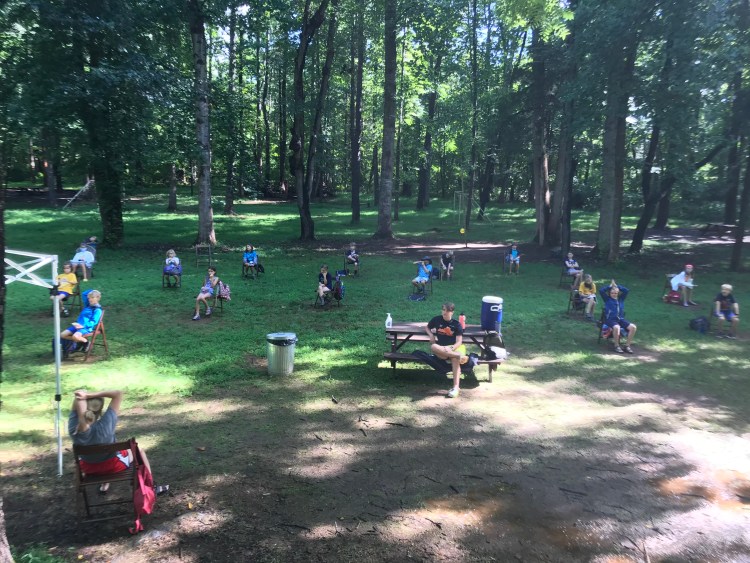
Follow Our Blog
Get new content delivered directly to your inbox.